Showing posts with label asian dowitcher. Show all posts

Monday, 13 August 2012

Wat Khao Takrhao & Laem Pak Bia

Milky Stork

Benedict and I headed off to Phetchburi province this afternoon for a look at Wat Khao Takhrao and thereafter onto Laem Pak Bia to coincide with high tide. I do hope I can start many more blogs with this introduction! It was fantastic to be out birding again and it was great to have Benny with me.

There was little to suggest that we were going to run into anything interesting. The drive through Khao Yoi was unremarkable. We saw a small flock of Painted Stork as we drove through the swamp to Wat Khao Takrhao. At Wat Khao Takrhao I was prepared for a good number of Painted Stork and some Spot-billed Pelicans and I was hoping there might be some sign of Great Thick-knee.

The story however was Painted Stork, in their thousands. Impossible to count: there was a huge central core of about 1,200 birds in the middle area of the big pool and then there were smaller groups scattered everywhere. A scan revealed a pair of Spot-billed Pelicans and then Black-headed Ibis, 16 of them: quite unexpected I hasten to add. There were also a handful of Whiskered Terns and 50-60 Lesser Whistling Ducks. In terms of waders there were good numbers of Black-tailed Godwits, some Common Greenshanks, Marsh Sandpipers and Wood Sandpipers.

Asian Dowitcher

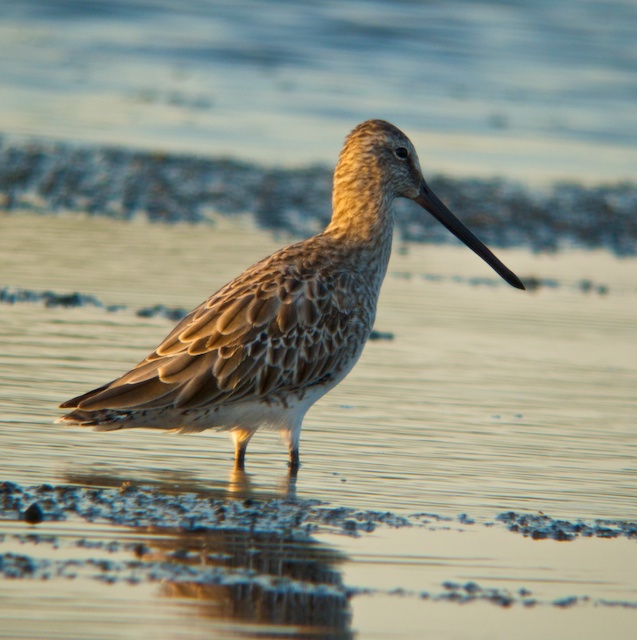
As we headed towards the temple I noticed some Godwits in one of the many pools and at this time of the year, with waders on the move, you dismiss them as a group of Black-tailed Godwits at your peril. I got a glimpse of a long, black bill with my bins and then of an incredibly strong whiter supercilium; I had the scope up in no time and all I knew was that it was neither Black-tailed nor Bar-tailed on the basis of the bill colour. I was hoping it would be a Long-billed Dowicher but that is just because I want lifers. Of course I didn't have a field guide with me so I had to get some shots of it. A call to Tom Backlund confirmed the likelihood of it being Asian. I think the photo confirms it is indeed Asian. I wonder where this fellow has come form and I wonder where his journey will end. While I took the shot Benny did splendid work in advising the oncoming traffic to be quiet!

We then drove to Pak Thale which rather surprisingly was as good as bird-free; I must confess it is almost virtually water-free right now as most of the salt pans are empty. Strange not being able to see a Curlew or a Lesser Sand-plover. No doubt it is going to get very busy here over the next few months.

We then headed down to Laem Pak Bia. Given the near dearth of birds at Pak Thale I thought they must all be down here. Five Spot-billed Pelicans and a small group of Painted Stork and little else other than some Redshanks. Except there was a Milky Stork in the among the Painted Stork. Now this bird has been around for a few weeks so I was really pleased to connect with it and I managed to get a few shots of it.

The Milky Stork is a pretty rare bird and in fact has an IUCN rating of Vulnerable. Its numbers are in decline with its stronghold in Sumatra, Indonesia. It pops up here infrequently usually in solitary numbers, tending to associate with flocks of Painted Stork. As you can see it could easily be confused with Painted Stork. The most obvious difference is the Milky does not have any pink feathering and the visible black feathers are restricted to the outer fringes of the wings when the bird is standing; the bill colour is different, a yellow pink whereas the Painted is orange, reminiscent of Cheddar cheese. I also rather fancy the Milky has a head fringe which appears to be lacking in the Painted; what I mean is the feathers extend more onto the Milky's forehead.

No sign of Great Thick-knees and not a lot else but a great afternoon and a great selection of birds.



Thursday, 29 December 2011

Asian Dowitcher at Samut Songkhram

Asian Dowitcher
Limnodromus semipalmatus
นกซ่อมทะเลอกแง
Don Hoi Lod, Samut Songkhram
29.12.11

I was a dutiful husband this morning and changed a tap in our kitchen which has been making a terrible racket for the last few months. What I thought would take 20 minutes turned into a 4 hour job so no birding today until this afternoon. So back I went to the salt pans near Don Hoi Lot, Samut Songkhram province to test my assertion that this area would be worth further investigation.

Common Redshank 
Tringa totanus
นกทะเลขาแดงธรรมดา
Don Hoi Lod, Samut Songkhram
29.12.11


I had a lot of fun observing and photographing the more common species: common redshank, brown-headed gull, little egret. There were a few raptors on the scene : a Brahminy Kite buzzing the gulls, a pair of Pied Harriers, female and juvenile, equally struck terror into the gulls just by flying over and a scruff bag Osprey flew over a couple of times. There were significant numbers of Greenshanks and Marsh Sandpipers, a couple of Little Heron, a Common Kingfisher flew low over the water and lots of egrets and Whiskered Terns. There were a few Caspian terns also for good measure. Conditions were well-nigh perfect: a gentle breeze mitigating the heat of a strong sun.

Gull-billed Tern
Gelochelidion nilotica
นกนางนวลแกลบปากหนา
Don Hoi Lod, Samut Songkhram
29.12.11


I also made the bird below a Black-headed Gull but the Birdforum gurus reckon it is a Brown-headed  Gull.I simply don't have the knowledge or experience in these matters. I was persuaded mainly by the dark iris; the Brown-headed has a noticeably lighter iris. If you want to offer an opinion please do so! I am not interested in controversy, let me stress, I just want to better my identification skills!


Brown-headed Gull
Larus brunnicephalus
นกนางนวลธรรมดา
Don Hoi Lod, Samut Songkhram
29.12.11


I decided late afternoon to head out into the saltpans and try to get some shot of a flock of Brown-headed Gulls. I made it to a shelter which was still a bit too far away from the gulls. There was a Gull-billed Tern within range and then a steady flow of Marsh Sandpipers and Greenshanks started to arrive in the pond nearest to my position. At about 1740h I noticed the arrival of what I thought was a Godwit and in my idle sort of way I thought I should get a shot of it and check out if it was Bar-tailed or Black-tailed. I knew immediately it was a dowitcher when I got the bird in my viewfinder - a distinct black, straight bill. For purely selfish reasons, ie my list, I rather hoped it would be a Long-billed Dowitcher but I thought it was more likely to be Asian Dowitcher. My maestro Tom Backlund has confirmed the ID as Asian.

Marsh Sandpiper
Tringa stagnatilis
นกซายเลนปึง
Don Hoi Lod, Samut Songkhram
29.12.11


I first saw Asian Dowitcher on the intertidal mudflats at Koh Libong, near Krabi in the south of Thailand, almost two years ago, so no lifer.  This time, however, it was much, much nearer and because of this the shot is about 100 times better! 

Common Greenshank
Tringa nebularia
นกทาะลขาเขียว
Don Hoi Lod, Samut Songkhram
29.12.11


The Asian Dowitcher turned a pleasant afternoon into a memorable one. I did not realise the Asian is a much more threatened species than Long-billed; it may simply be in Thailand that the Long-billed is much rarer. But globally the Asian has an IUCN Red List status of 'Near Threatened' and numbers are estimated to be approx 23,000, (BirdLife International). I also did not realise that Don Hoi Lot is a Ramsar site on account of the large numbers of solen regularis, or razor clams, or as my Thai hosts would say, "hoi lod" ( หอยหลอด). The Ramsar site  must be specifically the mudflats of the Maeklong estuary. This may also explain why it is not a wader hotspot: the presence of these molluscs must mean  a significant human presence and a resulting high level of disruption, especially at low tide. 

Such a Perfect Day
Sunset at Don Hoi Lod

Sunday, 28 November 2010

Laem Pak Bia: A Great Day's Birding

 Black-faced Spoonbill
Platelea Minor
นกปากช้อนหน้าดำ
Pak Thale, Petchaburi Province

I always have a great day's birding when I join up with Tom and our trip to Laem Pak Bia on Saturday was probably one of the best day's birding I have ever had. From my perspective it is great to bird with such a knoweldgeable and experienced birder and we both saw some great birds.

No sooner had we started just to the north of Cha-am in Bang Kao hoping to see Ruddy Shelduck than Tom is saying "Look a parakeet" and sure enough a noisy, small, green mass darts in off the sea and moves rapidly inland. That's as far as the identification went but it would literally and metaphorically have gone over my head had I been on my own. Bang Kao did offer great views of eight beautiful Painted Stork in the early morning sun and a host of shorebirds and brown-headed gulls and an Eastern Marsh Harrier glided over just as we were leaving. I am not sure about the status of the RSDs. No sign of them this morning nor later in the day when I returned to collect my car. [Update from T Backlund: one RSD was seen here on Monday 29.11.10]

Black-headed Ibis
Threskiornis Melanocephalus
นกช้อนหอยขาว
Wat Khao Takhrao, Petchaburi Province
27.11.10

Next stop at the abandoned building in Laem Pak Bia where we bumped into three Hungarian birders who confirmed the presence of a Long-billed Dowitcher and a Black-faced Spoonbill further north at Pak Thale. This news had Tom itching. Nothing much to report here but we went into the King's Project and had a nice time photographing a Little Grebe and Grey Heron. We were looking at a flock of black-tailed godwits parked in a salt pan nearby when the loud crack of canon fire from the nearby temple caused their sudden flight. These miniature style canons are used in temples to mark the beginning of events or the arrival of a special time. Tom got his camera out and started shooting the flock of birds. The resulting photographs show the presence of an Asian Dowitcher in the flock - by any standards a very decent bird. Of course this was the surprise in the can, so to speak, as neither of us was aware of this bird in the flock and Tom only realised it when he processed his photos on getting home. Elsewhere in a  flock of brown-headed gulls we saw a few Caspian Terns with their distinctive big bright orange bills.

Red-necked Phalaropes
Phalaropus Lobatus
นกลอยทะเลคอแดง
Red-necked Phalarope
Pak Thale, Petchaburi Province
27.11.10

So we then headed north to Pak Thale to what is known as the Spoon-billed Sandpiper site in pursuit of the Black-faced Spoonbill. There were plenty of shorebirds, thousands, but we were looking for a flock of egrets with the Black-faced in their midst. We had a fruitless march around during which Tom pointed out some Red-necked Phalaropes "spinning" in one of the salt-pans. Very elegant and really distinctive birds and lifers for me! We noticed that our Hungarian friends had come back to this site so Tom went off to check locations with them while I photographed the phalaropes. Fortunately we were looking in the wrong location so off we went. This meant I wasn't able to photograph the two Spoon-billed Sandpipers which were in the salt pan and of course when we came back they had gone!


Anyhow we walked into another salt pan as directed and the Black-faced Spoonbill was there surrounded by between 45 - 50 Painted Stork. What an amazing sight! I was grateful for the digiscope as I was able to get some decent record shots. We were probably between 150 - 200 meters away and this is the last sort of bird you want to scare off. A second lifer, a real beauty of a bird and something of a rarity in these parts.  

Photo credit © Tom Backlund
Asian Dowitcher
Limnodromus Semipalmatus
นกช่อมทะเลปากยาว
Kings Project, Petchaburi Province
27.11.10

We then headed north to Wat Khao Takhrao and after a spot of lunch we went in pursuit of the reported Black-headed Ibises. Over lunch I made the mistake of looking at my photographs and decided to change the  exposure setting as I thought my photographs were too dark. Well as a result my pictures of the Ibises are a bit washed out. I had the correct exposure! We quickly found the Ibises sitting in a bit of a marsh, two adults and a juvenile. Nearby a Black-shouldered Kite and Black Kite were perched in trees. I had already seen the Ibises before at Bueng Boraphet but nevertheless great birds to see and look at.

Thereafter we went back to Pak Thale in vain pursuit of Spoon-billed Sandpiper and we had a spin around the marshes and rice paddies looking, also in vain, for Grey-headed Lapwing. Pak Thale yielded lots of Marsh Sandpipers, Curlews, a small flock of Gull-billed Terns, and the usual suspets including one Sanderling. I think I had a Temminck's Stint, a stint with greenish legs, but it flew before I was able to be sure. I am happy to report there are lots of birds, lots of birds indeed. 

Tom headed home so we drove back to Bang Kao. From there I checked on the Ruddy Shelducks, nope, and then I drove back to see if I could take some more photographs of the Black-faced Spoonbill; not a bird to be seen at the site. I then headed home with an eye open for Grey-headed Lapwing but to no avail. 

What a great day's birding!

Saturday, 10 April 2010

Ko Libong

In the end our trip to Ko Libong turned into a rest which was very welcome from my perspective. In real terms though it was an excellent introduction into what I imagine will prove to be a very special birding area. I hope we can return and if we do we now know a little bit more about logistics which should make it easier to get around and make realistic plans.

I reported the sighting of the Asian Dowitchers with accompanying photographs. For my efforts, Phil Round, in effect the Thai recorder, advised me that, due to the photographs, he was treating my report as the first confirmed records of Asian Dowitcher for Ko Libong. I can also confirm the species is classified as "globally near-threatened" and my enquiries suggest that not a lot is known about this species.

Ko Libong, specifically the non-nunting  area, is a designated Important Bird Area, "IBA". I think the likelihood is the whole island is rich in bird and other natural life. One of the key tourist attractions is the possibility of seeing Dugongs or sea cows. I believe the forests will be worth exploration and will yield many species. We had a beautiful Paradise Tree Snake, chrysopelea paradisii, in the shrubs outside our bungalow.


paradise tree snake, chrysopelea paradise, Ko Libong 01.04.10


Key Sites for Conservation ( Bird Life International & Bird Conservation Society of Thailand, Bangkok, March 2004) describes Ko Libong as " a large inhabited island, several smaller satellite islands, intertidal mudflats, sandy beaches, mangroves, terrestrial forests,( including beach forest in a few areas), extensive sea grass beds, open sea and coral reefs". It goes on to say that Ko Libong is " an important staging area for migratory shorebirds and terns." It then says "Asian dowitcher ....... has been recorded at the site but is not thought to regularly occur in significant numbers."

In so far as tourism is concerned it is fairly undeveloped. I was spectacularily unimpressed by our accommodation: poor quality and very expensive. Sadly much of tourist southern Thailand appears to be about the redistribution of wealth, a crude exercise in overcharging simply in the basis of being a faraing. Thai people wouldn't be charged and wouldn't pay what we paid for food and accommodation. Once we discovered the villages our costs for eating and boat hire dropped and our morale improved accordingly! The locals, mainly Muslim fishermen and their families, were a delight.

I rather fancy a return visit this time next year with our new tent!!!!