Showing posts with label digiscoping. Show all posts

Sunday, 12 August 2012

Digiscoping and Post-production

The last two weeks have been difficult and challenging. When I should have been doing a lot of birding I have in fact been either too worn out or sick. We have had two consecutive long weekends. Last weekend exhaustion took hold of me and we scrubbed our scheduled trip to the wilds of Kanchanaburi province. It was the right thing to do as I needed the rest. This week I have been laid low by a severe case of the trots and it is only in the last 24 hours that I am getting back to normal. In the great scheme of things, fairly high class problems!

Long-toed Stint - unprocessed

Long-toed Stint - processed by Peter Ericsson

A week or so ago I was talking to Peter Ericsson about my images. Peter needs no real introduction as he is one of the best bird photographers in these parts. He told me he thought I should definitely be getting sharper images and he took one of my images and put it through Photoshop and in effect proved his point that "no image is done until it has been processed in PS". Peter's produced a tutorial which includes a basic PS treatment: it can be found here. Well the difference is very striking if you take a cursory look at the above two images.

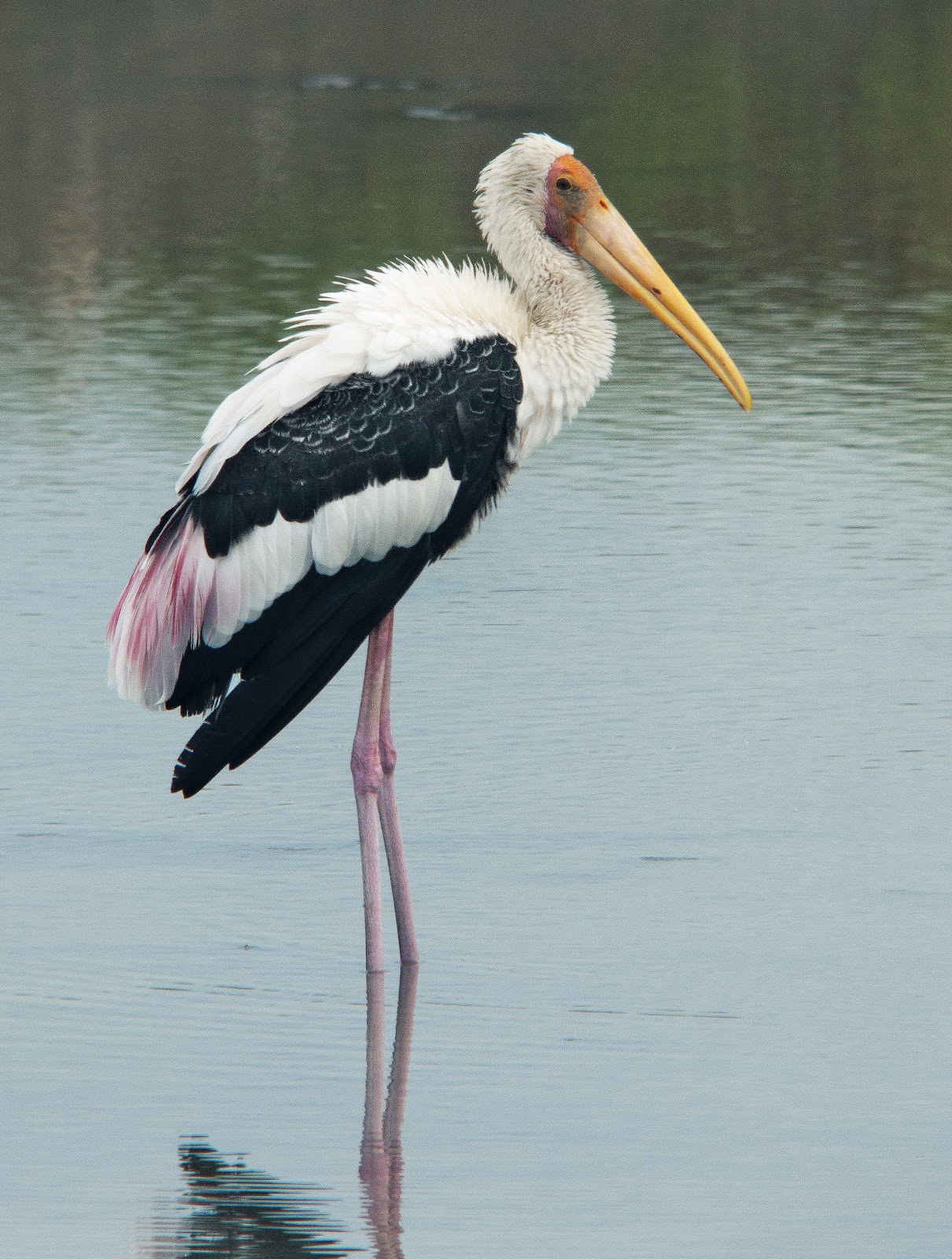
So it's perhaps just as well that I have been out of sorts as it has enabled me to start learning how to harness the power of Photoshop. I have managed to get some instructional material and I am working leisurely through this. The Painted Storks below are in fact the same file but the first one has been processed using PS. I have also cropped it so it is not quite like for like but post-production has really transformed the image.


I am also very pleased with this picture of a Great Knot dating back to February at Pak Thale. The PS processed image, with some cropping, comes first and the original follows. It really is a no brainer!


So it's good to get started finally on post-production and Photoshop. Up to now I have done most of my post-production in Aperture. It's pretty simple and offers a very effective solution for image management. Photoshop is very different however and I am very aware of really just dipping my toe into the water, so to speak.

My indisposition also lead to me purchasing a 2 TB external drive and I am going to try and archive my images. Good as this may sound, I reckon I am going to be deleting an enormous number of image files. However I am going to try to get through them because there are some images which I can improve with some post-production.

On reflection I think I have been lazy. I should have made more of an effort with Photoshop. However it is not a load it up and play it sort of programme. It needs effort. I think I have also been guilty of accepting inferior results. Digiscoping allows for many mitigating factors!

So let me thank Peter for pointing me in this direction and I hope to get out birding in the very near future.


Friday, 16 March 2012

Digiscoping News: Panasonic DMW-GF1 & 14-45 mm/ f3.5 - 5.6

Bronze-winged Jacana
Metopidius indicus
นกพริก
Ratchaburi  16.03.12


I must say that it is very unlikely that I would have made any progress whatsoever with digiscoping were it not for subscribing to Digiscoping Birds. Members have been generous in their support and help and it is a good place to learn about the craft and what actually works. If you are interested in digiscoping I strongly recommend you to subscribe and lurk! 

It is now recognised that an Electronic View Finder (EVF)  is an absolutely indispensable tool in the digiscoper's box. I have used a loupe to view the LCD since I started and they have limitations. A further factor is my camera of the choice, the Nikon P6000, has comparatively low LCD resolution, at 230,000 dots on its 2.7 inch screen. These factors really govern what you see when you are composing your image and are critical to focus; moreover the birds are rarely up close so getting tack sharp focus is challenging.

When a second-hand Panasonic GF1 kit came up for sale in Thailand a few days ago with an EVF I had to get it. No matter that the model is obsolete, no matter that there are higher specification cameras out there, this appeared to be a perfect camera and having checked with Tara Tanaka, 2011 Digiscoper of the Year and a major Panasonic 4/3 advocate, I didn't need any more encouragement.  The camera has a 3 inch LCD with 460,000 dot resolution. However it has an EVF and while the resolution here is less than the LCD and less than the Nikon P600 at 200,000 dots, the key is it allows the user to magnify focus.

My reading of the reviews was the GF1 was seen as a great improvement on the much lauded G1. It has been replaced by the new GX1. I had a look at the latter's specifications and to be honest I don't need a top of the range specification. The GF1's spec will be perfectly adequate for my needs and will get me started in the 4/3 camera world. I can wait for the much lauded Nikon V1 and the Panasonic GX1.

So the above shot of  a Bronze-winged Jacana would have been difficult at best with the Nikon P6000: I would have lost a lot of the detail and I doubt whether I would have managed to get sharp focus. This is the nub of the matter: the EVF enables you to zoom in for fine focus, no loupe needed. This shot is the result of fine focussing using the EVF, it's been cropped and tweaked a little; it won't win any competitions but there is enough there for me to think I am heading in the right direction. The bird was probably about 40 yards' distant. I used the 14-45 mm/f3.5 - 5.6 Lens attached to the Kowa 25x LER using the Kowa DA-10 adaptor. The lens's adaptor thread is 52 mm so it screws directly onto the DA-10 adaptor without any step rings. Vignetting disappears about 20 mm and the shot was taken at 26 mm.

A further factor in persuading me was the transaction would not attract customs duty which sometimes can add a further 20% to the total cost. Plus it included a 20 mm pancake lense, a spare battery and a release cable. I'll need to get a step-up ring to use the pancake lens; I am told this is a great lens.

So watch this space and hopefully you'll see better quality images as I get to know my way around this new system. But let me just say this set-up works and potentially works very well for digiscoping birds.

Saturday, 14 January 2012

A Mundane Saturday Afternoon at Don Hoi Lod


A short visit to Don Hoi Lot in Samut Songkhram province this afternoon, by recent standards, was disappointing. But I am not complaining. I had 3 species of kingfisher this afternoon, Common, Collared and Black-capped. I only managed shots of the Collared, however. There were about 60 Brown-headed Gulls but the ponds were comparatively quiet: the numbers of gulls, terns and waders were significantly down from my last visit. There were good numbers, nevertheless, of Common Redshank, Common Greenshank and Marsh Sandpiper; add in about 12 Bar-tailed Godwits. Pretty ordinary, really, but a pleasure to be out birding.


On the photographic front I have stopped shooting in RAW for the moment. My friend Tara, Digiscoper of The Year no less, commented that she noticed a grey cast to a lot of my images. She called it "shadowing". I have noticed this too especially when I shoot in .NRW and .JPG. The JPG images are much better: more lustre, better colour, better balance, hue etc. So I reckon it is something to do with shooting RAW and the settings either on my camera or in Aperture, my post-production software. That means reading the manuals - yuk!

Thursday, 24 November 2011

My 'New' Nikon P6000

Common Snipe
Ratchaburi
24.11.11

I have to say I am getting a really good feel about my 'new' digiscoping camera, a used Nikon P6000 I bought off a fellow digiscoper in the US. In fact it feels better than the one that died and caused me so much grief. It's been a little bit frustrating this week because the light at the moment is usually on the wane from about 17:00h and gone completely by about 17:40h. Far from ideal for digiscoping. However this snipe in the local rice paddy in Ratchaburi was in the setting sun tonight with me in between. I am quite pleased with the shot. I used a sun shade which came with the camera. Normally I use a loupe with a diopter. I don't think the focus is perfect in this shot but I think it is better than when using the diopter. A little bit too early to say for sure. Hopefully this weekend I'll get out into some decent light and see what the results are. But I am really encouraged by this.

Tuesday, 11 October 2011

Digiscoping Blues, Malaysia

I'm off tomorrow to Malaysia where I hope to do a little pelagic birdwatching in Kedah, north west Malaysia and spend a few days in Ulu Muda National Park on the Thai-Malay border. This is home to many exotic bird species including Plain-pouched Hornbill. I made contact with Dave Bakewell, a British birder based in Malaysia and Dave very kindly has steered me in this direction.  You can read a report of Dave's visit to Ulu Muda last month at this link. I'll hopefully tell you a lot more about it after next weekend.

I spent today in Bangkok trying to find a replacement camera following last week's debâcle. Nikon can  repair my P6000 but at a cost of 20,000 THB, about £400.00 GBP - ouch, no thanks. Unfortunately the camera is now obsolete;  but I did see a store in Bangkok selling it off brand new for 12,999 THB less than a month ago. So a replacement is the order of the day and I rather fancied the Panasonic G3 with a 14-42 mm lens. I tried it out today with the Kowa 25x LER and the 20-60x zoom eyepieces but I could not eliminate vignetting at any focal length on either lens. So I left it for today.

I think the solution is probably to use  the Kowa 30x wide angle eyepiece and then I'll be able to use the Panasonic lenses. Fortunately I have my old Nikon P5100 as backup and that will have to do for Malaysia and for the immediate future. So no pics or birdwatching but I am looking forward to my trip. Watch this space.

Wednesday, 20 July 2011

The Histogram

Asian Koel - female
Eudynamys scolopacus
นกกาเหว่า

By consequence of being laid low I took some time to look carefully at some of my digiscoped photographs over the last year. Somehow or other I found myself learning about tonal histograms and "blinking highlights". In other words incorrect exposure and as a result the many might-have-been shots on my hard drive. More to the point I have discovered what I should know already: how to use the histogram to get a good image.

Now the depressing thing is that in a lot of my shots the highlights are blown as are my shadows.And I went out tonight to try and give effect to what I have learned. I am really very pleased with this female Asian Koel which I shot in dodgy light in the final hour of daylight today. It's a lovely bird and bucks the trend of the male bird having the good looks. Thanks to the bird being quite settled I was able to take a few shots, look at their histograms and then make adjustments. There are no blown highlights in the above and the shadows and blacks are likewise within scale. This is a first step and as I say the light wasn't very good so I am pleased to get this shot of this bird. I am pleased with the detail. It's another step up the learning curve and I hope it's going to give me some decent shots.


Ashy Woodswallow
Artmaus fuscus
นกแอ่นพง

 I am equally pleased with this Ashy Woodswallow, a bird I have found very difficult to photograph. Once more I am pleased with the range of tones especially the lighter ones in the bird's bill which nevertheless have some good detail. This is a very exciting moment in my development!


Tuesday, 3 May 2011

Digiscoping:DSLR compared with Compact


There was an eight minute difference between taking both shots. I am happy to concede both are poor shots but it is self-evident which one is the best, the upper one. As my guru Tara advised the Nikon p6000 compact will produce a better and sharper image under all circumstances than the Canon EOS Kiss x3 with a 60 mm macro lens. I would hardly describe the test as scientific however. I know what I am doing with the compact when I am digiscoping. I don't know with the Kiss x3. Even if I did I am not sure it would produce a better image. However I will try again and lock the mirror and shoot with a remote and see if I can get better results.


Tuesday, 26 April 2011

Digiscoping with a DSLR


I am really encouraged by these three shots taken with the Kowa scope, the Canon EOS Kiss x3, DA10 and adaptor ring and Canon 60 mm E-FS Macro Lens. The Openbills were about 120 metres away and the Intermediate Egret was between 400 - 500 m away; the first and last pics are cropped. Not bad, I say. This is not an easy set-up - there is a lot of weight on the tripod and because my scope is angled I worry about the pressure of the weight of the camera and lens on the eyepiece and telescope. It's hard to steady the rig especially with wind. A tiny amount of vibration  takes the edge off focus. As I mentioned yesterday however there is no vignetting. It is not as responsive or easy to use as it is with the Nikon P6000; that, however, may be down to relative unfamiliarity with this rig. But there will be times when this set up will be excellent: large flocks of sitting waders. I have to say I am very excited by this development.

Wednesday, 20 April 2011

For my Muses at Yahoo's Digiscopingbirds

Oriental Pratincole
Exif Data: ISO 64 20mm f/7 -0.7ev 0.01484s 

Small Pratincole

Exif Data: ISO 64 24mm f/7.7  -0.7ev 0.01661s 

Exif Data: ISO 64 20mm f/7  -0.7ev 0.01134s 

These shots are straight out the camera and shot in late afternoon sunshine with about 1.25 hours of daylight remaining. I am getting progressively happier with my shots so thanks for the steers and advice.

Wednesday, 3 November 2010

Mid-week Bulletin

Huay Mai Teng Reservoir
Ratchaburi Province
31.10.10

Four weeks ago a road continued to the other side of Huay Mai Teng reservoir where you can see a small piece of roof in the above picture!

On Sunday I went back to the reservoir early in the morning and had a good look at the female pied harrier and a black kite. I also had a pair of common kingfishers in my sights but I just couldn't take a decent photograph of either. So below is a blooper and I am not really sure what went wrong. Perhaps it was just too early in the morning and the light was not good enough, ASA too low, very gray early morning light or maybe I wasn't good enough. Most likely a combination of them all! Whatever it is good to know that the harriers are back and I expect they will arrive in Ratchaburi soon.

Common kingfisher - digiscoped blooper!

The EOS saves the day!


EOS snaps of Green Bee-eater
Paddyfield Pipit
Huay Mai Teng Reservoir, Ratchaburi
31.10.10
News filters through of an Amur Falcon being seen at the Chumphon Raptor Watch and more significantly of about another 1,750 Amur falcons, 2 Himalayan Griffons, 2 Steppe Eagles and 1 Imperial Eagle being observed at Chiang Dao in the far north of Thailand. One of the Thai language boards has reports of Heuglin Gulls at Laem Pak Bia. I was reading Wansteadbirder's blog about a twitch from London to the South-West of England to view an American bittern. He's posted an amazing photograph of the mass of people  assembled to view the bird and the account of the twitch is highly entertaining. Well I am not heading north or south to pursue the Amur falcons! Such crowds are unheard of in connection with bird watching in Thailand. Thank God! There would have been a time in my life when I would have gone for it but thank God for a bit of common sense in my life these days! Not that much I hasten to add.

I went out locally last night hoping to see harriers sweeping the rice paddy. Instead I  saw a black-capped kingfisher, the first of the winter and tonight it was in the same location with a white-throated and a common kingfisher in the very near vicinity. Three species of kingfisher within a kilometre of home is good! The black-capped is very elegant with very striking collars and a very distinctive red bill. If I am right he is a migrant.


I have been taking soundings on an internet digiscoping board and hope I can apply some of the help and tips that have been offered and publish a few more decent shots this weekend. If you would like to see a brilliant picture of a great egret please go to my friend Tara's flickr.com gallery. More at the weekend, I hope, but I have significant work commitments this weekend so may be only a little bit of a blog!