Friday, 17 September 2010

Ratchaburi Town: River Lapwing

River lapwing
Vanellus duvaucelii
Ratchaburi Town
17.09.10

I found myself unexpectedly free for the last hour of available light today and took my rig round to the local rice paddy, about 1 km from here.  I thought I would practise on common birds with my new toys. When I got there I thought it was going to be a waste of time as it was very overcast and big, dirty rain clouds were forming. And then in a wet paddy I saw a black head and grey body in among the common red-wattled lapwings and I thought: "River lapwing" and sure enough, there was one. A solitary river lapwing with about 8 red-wattled lapwing, some cattle egrets, a chinese pond heron and a couple of white-breasted waterhens. A first for this sorely neglected patch. As I fumbled to get a picture a person walked into the birds' safety zone and off they flew but they came back about 5 minutes later and notwithstanding the poor light, I got the above, usable shot, a record shot.

There is no doubt, the river lapwing is my bird! I can't think of when I ever went birding and had a bad time, when I was disappointed. Sure you could drop your bins into the drink, but......I'll let you now when I have had a bad day birding!

Wednesday, 15 September 2010

Bird Ringing at The King's Project, Laem Pak Bia


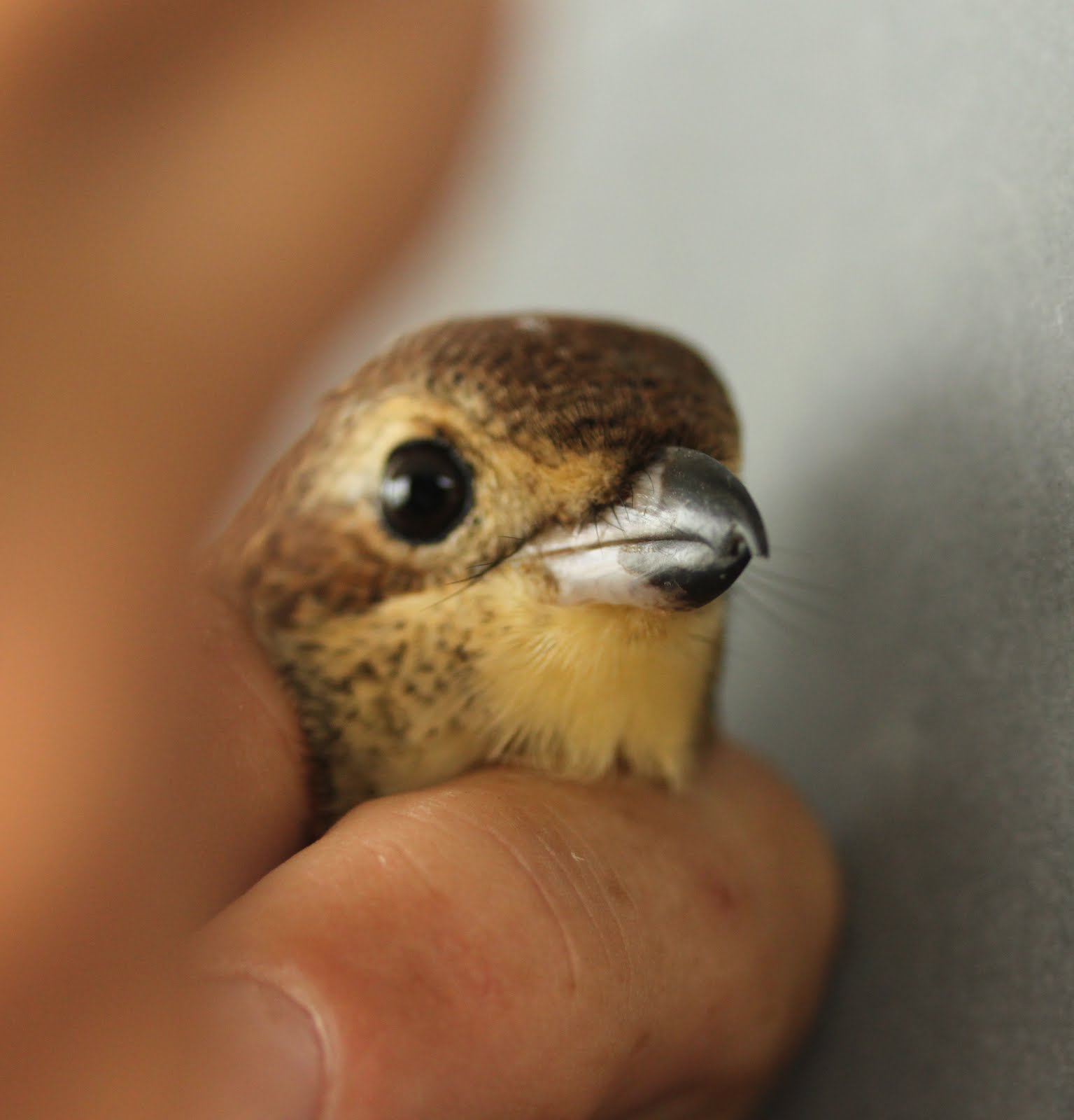
I joined Phil Round and a few others on Sunday to assist with bird ringing at the King's Project, Laem Pak Bia. I now know how to handle a bird! What a brilliant way to learn more about the science. The Pied Starling above is in my own hand, head between my index and middle finger and the camera in the other. I never knew where a birds ears were located until this moment: and, of course, in true buffoon fashion as I consult my avian topography chart, this explains why the area is called the ear coverts! This is the cream coloured area to the left of the eye and if you look you can see an upward diagonal line. That's the fellow's ears.


A common kingfisher in the hand and below a tiger shrike, juvenile. If you look closely at the latter's bill you will see a slight kink in the upper bill just below the point. Phil explained this is to facilitate it in ripping flesh! This is a passage migrant on its way to warmer climes for the winter.

Now let me disabuse you of any notions that I did any hard work. I was a passenger and handled a few birds. Phil and his assistants are the real grafters and have been doing it for years, a real labour of love. I was distracted by the pelicans and the photo opportunities they offered.


Basically this is what happens: birds are trapped in mist nets which are emptied every 30 minutes. The birds are transferred into individual small cloth bags and transported to a processing centre. Here they are fitted with a small, light band/ring on their right leg. The  rings have a unique identifier number and the details are entered on a database. The bird is weighed, measured, sexed and aged. Birds of interest  are photographed as below and are then released. I must stress the whole operation is built around the welfare of the birds and everything is done in such a way so as to minimise distress to the birds.

Now there is more and more ringing happening all over the world so birds are being retrapped everywhere and  this process is helping the scientific community to exchange information and indeed to  build up reliable information about birds' vital statistics. So I salute Phil Round and other banders and hope in time I can do a bit more and contribute to this really important work.


A view of the tiger shrike's primaries.


A female yellow-rumped flycatcher, above and below. Now you know where its name comes form! We also had an eastern crowned warbler. These are two important passage migrants. Phil was very pleased with the session as it included a number of retraps plus the passage migrants. I hope in time that I can offer more assistance.
I can claim a tiger shrike as a lifer as one perched on the branches near the banding station so it counts as a true wild bird.

Sunday, 12 September 2010

Upward Learning Curve!


Some of today's captures from The King's Project, Laem Pak Bia, Phetchaburi Province. I love the spot-billed pelicans. They are such big, peaceful birds with a look of being utterly out of place. There were 19 present this morning and in fact they represent a significant challenge....becaue of the variation in their plumage, grey through bright white.  The digiscope really comes into its own here. I was able to keep my distance and not disturb the birds and manage a few decent shots.


I think this is a great cormorant which is not exactly a commoner and not a regular visitor in the King's Project. A difficult bird to photograph because it gapes, very rapid movement around the gular area, the throat, which is how it keeps cool!


I am very pleased with these shots of this great egret. They are not completely washed out and I have managed to get some shadow in the main white body. They key advance in learning has been to start shooting with the camera lens on infinity, so the autofocus is off and all the focus is done on the scope; this means no last minute operation of the autofocus as I press down the shutter. I have a new head and some other bits coming in the next few days which I hope will lead to sharper, better images. You need to remember most of these shots are taking on a 3 second timer to reduce shake. 


 And finally a little cormorant.

Wednesday, 8 September 2010

The Sirindhorn International Environmental Park, Cha-am

Common hoopoe
Upupa epops
นกกะรางหัวขวาน
Sirondhorn Environmental Park, CHa-am
08.09.10

I had a brief look at a few fairly common birds today during the school's educational trip to Sirindhon International Environmental Park. 160 rampant kids are not ideal birding companions! However these axe birds as the Thais call them, or rather, common hoopoes, were very obliging. These were taken with my EOS 500D with the 85-250 mm zoom. I'll photograph any bird and hoopoes may well be commoners but, you can see for yourself, they are very striking creatures. Elsewhere we saw a little heron, a pacific golden plover, common sandpiper, coppersmith barbets, olive-backed sunbirds, little egrets, little cormorants, lesser sand-plovers...... what you would expect. If you were stranded in the Hua-Hin/Cha-am area on a  "conventional"(!)  holiday you could do a lot worse than here. Nice friendly people, good facilities, a decent mangrove walkway, a good stretch of beach, restaurants, toilets ...... Bring the family. There is also a decent exhibition on environmental protection/sustainability themes.


Tuesday, 7 September 2010

More Huay Mai Teng


Pied kingfisher is one of my favourite birds, so striking to look at. I went back to the reservoir yesterday, briefly, as I thought the common kingfisher would be about and I really wanted to try to get a few shots of it. Alas no, but no complaints as this fellow makes an excellent alternative. The pics are poor but they highlight some of my issues. You see the leaves in front of the bird, huh?! Well they are in focus but not the bird! Add in vibration from the wind ....... I am not making excuses! But one day I hope to bring you a striking capture of this bird, in focus with "wow" factor! 

Sunday, 5 September 2010

More Huay Mai Teng

I took my new birding companion Tom and his wife Nid up, to Huay Mai Teng Reservoir this afternoon and the River Lapwing duly obliged, once more seven present. Phew! Not for long as they flew off almost on arrival. A lifer for Tom. I had just got my rig assembled and, you got it, off they went. Plenty of good birds today: an osprey high in the sky being a new bird for this patch, but no surprises as this is where it should be! Plenty of oriental pratincoles and two pairs of pied kingfisher. Tom had the urge for lifers and scoured hard for a small pratincole, but alas no, not today. Some reasonable shots showing progress.


I saw three species of kingfisher today : pied, white-throated, & common. I've got a bad shot of the white-throated for the blooper category. Distance and poor light at the end of the day are my excuses. The common didn't wait for me to get set up but I might go back tomorrow afternoon and try to find it because it is a really beautiful bird. Light was behind the bird.


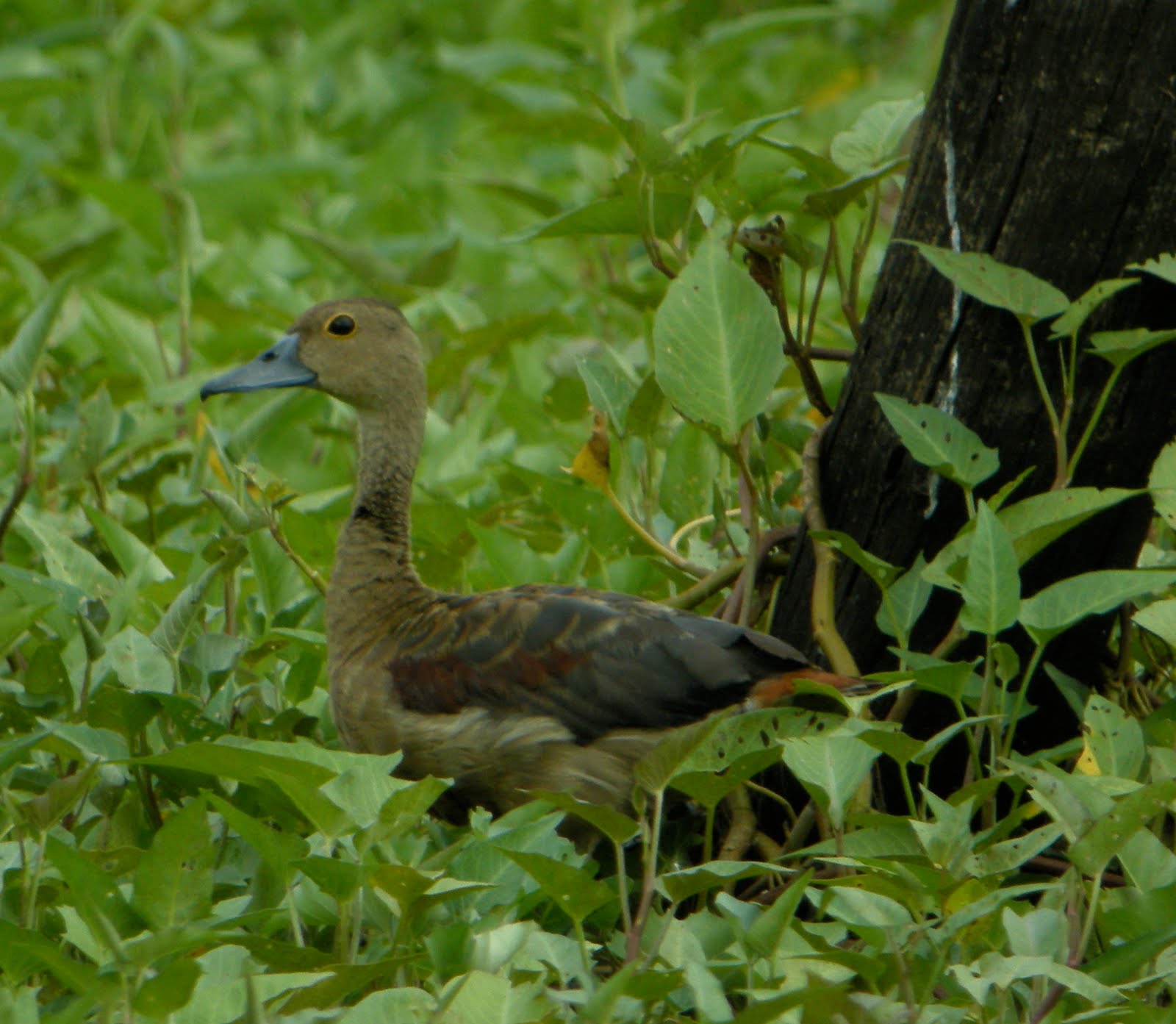
I am reasonably happy with these pictures of a lesser whistling duck. Taken as the light was going, a good distance away and passable.


There is no doubt in my mind that there continues to be improvement. First of all I am getting more and more to grips with the camera operation. I am getting better and faster at getting the bird into my LCD. I am getting better with focus but by no means perfect. I have a lot to learn about exposure. I have no doubt a cable release and a couple of other gadgets that I am in the process of ordering are going to make a huge difference to the quality of my photographs. But I am really enjoying this new development and I believe some time soon I will produce some really good images.

I can see a time in the near future when I shall buy a portable blind (hide) and sit in it for a few hours. This weekend I spent a couple of hours sitting on a deck chair by the water and I have to say it was just such a perfect, relaxing feeling. Watch this space!

Saturday, 4 September 2010

Huay Mai Teng Reservoir, Ratchaburi

River lapwing
vanellus duvaucelli
นกกระแตหาด
Huay Mai Teng Reservoir
Ratchaburi Province
04.09.10

This reservoir never fails to deliver. Today an afternoon jaunt essentially to practise with my digiscoping rig threw up 7 river lapwings. These fellows won't be around for much longer as they come here to breed along with oriental pratanicoles of which there were many. I was also hoping to see rain quail but not today.

Peaceful dove
geopilia striata
นกเขาชวา

Digiscoping is most assuredly not point and shoot. I am still struggling with focus and composition but I am clearly improving. So I took advantage of shooting this dove which was much more obliging than the  lapwings. Good for practise!


I have to publish this picture of a dragon fly. Later in the afternoon I was relaxing in my chair by a pond when I decided to take a look at a dragonfly with my bins. I am glad I did. This fellow was close to me and was very obliging. I have to say I am very pleased with this. There is hope!

There were some great birds about today. I saw some bronze-winged jacanas, a yellow bittern, two pied kingfishers, and all the usual suspects. 

Here is a beautiful flower I captured with my 60 mm macro lens. I guess it is some sort of water lily.


Here are a couple of my bloopers, a bronze-winged jacana and a yellow bittern.


Both were shot late in the afternoon, in the final hour of daylight and the bittern was an attempt to get a light reading but of course the bird flew once I had my reading!!! The jacana was a fair distance away. 

There you have it, a real joy.