Monday, 19 March 2012

Messing Around

Blue-tailed Bee-eater
Merops philippensis
นกจาบคาหัวเขียว
Ratchaburi Rice Paddy 19.03.12

I got out of my sick bed for the first time in more than two days to play with my new toy late this afternoon. We've all been laid low with bronchial infections, including the baby; I appear to be the worst affected. After three days of antibiotics I am still coughing but I do feel better. Thank God we're all on holiday. Not a lot of action in the rice paddy, simply good to be out. This Blue-tailed Bee-eater perched up just a little too far away. Mustn't grumble; learned a little more about the GF-2 operation and must say I do like it. The shot below of the same bird gives a flavour of what might be possible. Shot at 400 ISO and then brightened - the light was all wrong. I didn't shoot a burst, this is a single frame!

Blue-tailed Bee-eater
Merops philippensis
นกจาบคาหัวเขียว
Ratchaburi Rice Paddy 19.03.12


Friday, 16 March 2012

Digiscoping News: Panasonic DMW-GF1 & 14-45 mm/ f3.5 - 5.6

Bronze-winged Jacana
Metopidius indicus
นกพริก
Ratchaburi  16.03.12


I must say that it is very unlikely that I would have made any progress whatsoever with digiscoping were it not for subscribing to Digiscoping Birds. Members have been generous in their support and help and it is a good place to learn about the craft and what actually works. If you are interested in digiscoping I strongly recommend you to subscribe and lurk! 

It is now recognised that an Electronic View Finder (EVF)  is an absolutely indispensable tool in the digiscoper's box. I have used a loupe to view the LCD since I started and they have limitations. A further factor is my camera of the choice, the Nikon P6000, has comparatively low LCD resolution, at 230,000 dots on its 2.7 inch screen. These factors really govern what you see when you are composing your image and are critical to focus; moreover the birds are rarely up close so getting tack sharp focus is challenging.

When a second-hand Panasonic GF1 kit came up for sale in Thailand a few days ago with an EVF I had to get it. No matter that the model is obsolete, no matter that there are higher specification cameras out there, this appeared to be a perfect camera and having checked with Tara Tanaka, 2011 Digiscoper of the Year and a major Panasonic 4/3 advocate, I didn't need any more encouragement.  The camera has a 3 inch LCD with 460,000 dot resolution. However it has an EVF and while the resolution here is less than the LCD and less than the Nikon P600 at 200,000 dots, the key is it allows the user to magnify focus.

My reading of the reviews was the GF1 was seen as a great improvement on the much lauded G1. It has been replaced by the new GX1. I had a look at the latter's specifications and to be honest I don't need a top of the range specification. The GF1's spec will be perfectly adequate for my needs and will get me started in the 4/3 camera world. I can wait for the much lauded Nikon V1 and the Panasonic GX1.

So the above shot of  a Bronze-winged Jacana would have been difficult at best with the Nikon P6000: I would have lost a lot of the detail and I doubt whether I would have managed to get sharp focus. This is the nub of the matter: the EVF enables you to zoom in for fine focus, no loupe needed. This shot is the result of fine focussing using the EVF, it's been cropped and tweaked a little; it won't win any competitions but there is enough there for me to think I am heading in the right direction. The bird was probably about 40 yards' distant. I used the 14-45 mm/f3.5 - 5.6 Lens attached to the Kowa 25x LER using the Kowa DA-10 adaptor. The lens's adaptor thread is 52 mm so it screws directly onto the DA-10 adaptor without any step rings. Vignetting disappears about 20 mm and the shot was taken at 26 mm.

A further factor in persuading me was the transaction would not attract customs duty which sometimes can add a further 20% to the total cost. Plus it included a 20 mm pancake lense, a spare battery and a release cable. I'll need to get a step-up ring to use the pancake lens; I am told this is a great lens.

So watch this space and hopefully you'll see better quality images as I get to know my way around this new system. But let me just say this set-up works and potentially works very well for digiscoping birds.

Pak Thale & Laem Pak Bia

Spoon-billed Sandpiper
Calidris pygmeus
นกชายเลนปากช้อน
Laem Pak Bia 12.03.12

Thanks to school holidays I was able to meet up with Dean Nicholson from British Colombia, Canada yesterday who contacted me as a result of reading this blog. In the end we decided to hit Pak Thale and Laem Pak Bia, Thailand's premier wader sites. Dean brought Hans Matheve, from Belgium, whom he met in Kaeng Krachan a few days earlier. Hans brought his non-birding girlfriend along too. So in real terms we were mob-handed! Much more importantly we managed to meet up in Phetchburi on time and at the agreed location - no mean achievement!

Our first target was Black-faced Spoonbill, two of which have been reported regularily and appear to favour salt pans near the gas holders at Pak Thale. We had a good look but couldn't locate them. We did see good numbers of Painted Stork however and we had some debate about whether a whitish bodied bird, with black fringing at the base of its wing edges as it stood up, was a Milky Stork, another regularily reported rarity from the same area. We agreed it wasn't. I have to say that having just reviewed the photos on Oriental Bird Images I think we might have got this wrong and that it was in fact a Milky Stork!

In Pak Thale we had to work to find Spoon-billed Sandpiper but we did in the end see one in salt pans towards the mudflats. Hans called it and he and Dean walked in a little bit to get better views. Phew! Always a relief to sight this fellow and I was delighted for our visitors. Lots of Lesser Sand-plovers, some Greater Sand-plovers,  good numbers of Kentish Plovers, a fair few Broad-billed Sandpipers, a handful of Great Knot, and the resident flocks of Curlew and Black-tailed Godwits.

Next up we headed to the sand spit at Laem Pak Bia. I had arranged beforehand that Mrs Daeng would serve an early lunch at 1030h and I have to say it was perfect. Mr Daeng got us onto the sand spit and the undoubted highlight was a Pallas's Gull, identified by Hans as first winter. In fact Hans gave a mini-lecture on why it was a first winter and its key diagnostics: grey streaking around the eye, long thin bill with black tip, streaking on the neck, white upper tail covert....... So helpful to have such expertise to hand when this type of bird is in front of you. No less Thai  lifer ⌗322 for me. I have to say this gull is huge and dwarved the Brown-headed Gulls and Crested Terns which were keeping it company; a brief aerial display confirmed other key diagnostics not to mention its comparative enormous size.

Five Lesser Crested Terns were in a mixed flock of Greater Crested Terns, Brown-headed Gulls and Little Terns. Abundant numbers of plovers with 6+ Malaysian Plovers but no White-faced. One solitary Chinese Egret and on the way back we had a Heuglin's Gull on a small sand flat opposite the sand spit: once more a massive bird, dwarfing the four Brown-headed Gulls which it was with.

We decided to keep our focus on waders so next we went to the Abandoned Building and Dean got very lucky here with a number of lifers including Ruff, Indian Nightjar , Indochinese Bushlark and Plain-backed Sparrow.. It was good to see birders putting themselves out to get a decent view of Plain-backed Sparrow because as I have often said before, it isn't plain. Dean flushed the nightjar which left a fledgling behind. I hope they manage to reconnect


We then decided to head north back to Pak Thale for the final chapter in our day's birding. Even though it was low tide there were still good numbers of waders in the ponds near the mudflats. Here we were excited by the possibility of a Sharp-tailed Sandpiper but after exhaustive enquiry and observation, we decided we couldn't claim it and that it was more likely a Long-toed Stint! Our cause was not helped by distance and the fact that the bird was onnly showing its rear quarters. We also took a lot of time observing Curlews feeding on the mudflats and were drawn into the possibility of one being Eastern: it appeared darker, had a longer bill which seemed to start straight and only curve downwards at about three-quarters of its length. We looked, looked and looked but it wouldn't give us a sight of its uppers or unders so we had to give up on it as a "curlew species". A number of very busy Terek Sandpipers were seen busily feeding on the mudflat.


A great day's birding indeed. Thanks to Dean and Hans for their expertise and good company. As we drove into Phetchburi town I stopped the car to view an unfamiliar shape in the sky, quite low down. Mmmmmmm, a kite! As in a toy kite! 


So few photographs? Yup! On Wednesday I went to the Eastern Seaboard, alternatively the Pattaya overspill, where I bought a second hand Panasonic GF1. It was such a good offer I could hardly refuse it. The package included an Electronic View Finder. Well I managed to leave the EVF at home! So I decided not to bother with photography today. Not an auspicious start but I have high expectations that once I have learned the camera.


I did fiddle with a loupe and managed a usable shot of Spoonbill Sandpiper. In this instance the bird is of no consequence. What is significant from a photographic perspective is even though  the bird was 60 - 70 yards away, the focus and sharpness is a significant improvement. I doubt whether I would have been able to produce a usable image with old faithful, the Nikon P6000. To underline this check this two shots of a Yellow-vented Bulbul taken Wednesday at Bang Phra Non-hunting Area, Chonburi province.


The above is uncropped and I haven't tweaked it in anyway. It's an unremarkable, bland shot of a bird that is a bit out of reach. However the focus is sharp. So look at the same image cropped below. Not a great image either but the detail is good and as far as I am concerned it is a significant improvement on old faithful. The crop would have been much more blurred. The new camera enables finer focus.


So upwards on the learning curve I proceed and I hope there will be a corresponding improvement in the quality of my images, once of course I have learned the new camera and system and so long as I remember to bring the EVF!


Monday, 12 March 2012

Some Birding Sites in West Central Thailand


The highlight of a truly outstanding day's birding was sighting 2 pairs of Small Pratincoles on the ground in the usual place at Huay Mai Teng Reservoir, Ratchaburi Province. This time last year there were more than fifty pairs and I had been able to watch their numbers build from Christmas Day 2010. They were a significant presence and it was quite clear they were nesting. I hope that as far as this year is concerned numbers will now increase.

But a truly outstanding day, a day of superlatives. I was joined by Dave Sargeant and we met up with Tom Backlund. It is a real privilege for a rank novice like myself to be in the company of such experienced birders, true lifelong devotees of the craft. I had agreed to show Dave around some of the local, "lesser" sites. Tom was able to join us. As Tom and I always wax lyrical about Wat Khao Takhrao in Phetchburi Province this seemed a good place to start.


Thanks to Dave's sharp eye and strong sound recognition skills respectively I started with two lifers, a Wryneck (⌗319) and soon after a Laced Woodpecker, ,(⌗320). I might have got the Wryneck but no way would I have got the woodpecker; at the very best I would have got "woodpecker sp." but sound enabled Dave to find it in the upper story of some tall trees adjacent to the big pond at Wat Khao Takhrao, and then to confirm the identity, notably to separate it from Streaked Woodpecker. We were all hoping that Tom's recently sighted Comb Ducks might show but alas,no sign today. Plenty of ducks, however, somewhere in the region of 1200 Garganey and lesser numbers of Northern Pintail. No other duck species. Lots of Brown-headed Gulls, a number with their very distinctive Brown-headed breeding plumage, lots of Caspian Terns, Whiskered Terns and a couple of Little Terns. We also had three aerial Black-headed Ibis and I managed to pick one out at ground level.


Next we decided to head south to the dipterocarp forest at Wat Khao Look Chang, about an hour's drive away. Almost immediately on arrival I managed lifer ⌗321 with a couple of Rufous Treepies. There were a lot of good birds: Red-billed Blue Magpie, (sound), Lineated Barbet, Red-breasted Parakeet, Indian Roller, Green-billed Malkoha, Lesser Necklaced Laughing Thrush, Greater Racket-tailed Drongo but no woodpeckers and no sign of Spotted Owlet. We also had a glimpse of a sizeable kettle of migrating raptors but they were too high to be able to identify.


After a pleasant lunch we bade farewell to Tom. Dave and I then decided to head north to Huay Mai Teng Reservoir in Ratchaburi province, just under two hours away. On arrival at the southern side of the reservoir we observed one Eurasian Coot and Dave picked out a notable new species for the reservoir, a Grey-headed Lapwing; the numbers of Oriental Pratincoles continues to grow in this area. There were also a few Red-throated Pipits


We had a little scout around the site during which Dave managed a Rufous Woodpecker which I  missed; it would have been another lifer. We had stopped to try and get views of a Small Buttonquail which had scrambled across the track and disappeared into the scrub. A nearby  perched Eurasian Kestrel moved as we closed in for a photograph and Dave had that experience every bird photographer has -  shot composed and about to release the shutter when the bird, in this case an Oriental Pratincole, legs it. We had to make do with Yellow-eyed Babbler - good to see this fellow as much of his habitat at the site has been destroyed to make way for planting.


Back at the main birding site for the last light of the day, we hit pay dirt. Four Small Pratincoles were on the ground in the usual place. It is usually possible to get quite close to these birds and get some decent shots and using Dave's car as a hideI managed some reasonable shots.  Rain Quail responded to a little playback and we estimated we sighted between 15 and 20 of these as we moved around in vain efforts to get a view of some of them on the ground. We also flushed a Savanna Nigthjar. In the final light of the day an Oriental Darter flew directly over us on its way to roost.


Notwithstanding the dark we were by no means finished. Dave got out his sound recording gear and I believe he managed to get good quality recordings of the Savanna Nightjar's call as a number of them exuberantly circled around us in full voice. Earlier efforts had been frustrated by the loud noise of jet-ski engines on the reservoir. There were also clear calls from at least two Indian Nightjars.


We hit the road at 0530h and finally made it home to Ratchaburi at about 1930h. A classic day's birding and I remain overjoyed at the return of the Small Pratincoles. I didn't do a lot of shooting today. It was quite overcast, with some light rain in the morning and with the exception of the Small Pratincoles I didn't really get close to any birds today. But I am not complaining! Good to be able to focus on the birds per se

Wednesday, 7 March 2012

Khao Look Chang, Phetchaburi Province

Spotted Owlet

Well less than 24 hours since my disaster I have my truck back, fully repaired and probably driving better than at any time in the three years I have owned it. The rescue and repair cost 5850 THB, that is about £115 GBP. I am a fortunate fellow. So I had to go to collect it today which meant another trip to Kaeng Krachan. I discovered there are vans running to Kaeng Krachan village from Petchaburi so it is possible to get there by public transport. However birders and visitors will still need to arrange transport from the village to the park and indeed up the mountain.


To celebrate my good fortune I decided to go to Wat Khao Look Chang, a nearby dipterocarp forest adjoining a temple. I was hoping for Black-headed Woodpeckers. I also stopped in at the animal refuge there which is managed by Wildlife Friends Foundation Thailand; I hitched a ride yesterday in Kaeng Krachan in a car which was transporting some of their volunteers. A worthwhile visit as I learned a little about the refuge's current situation and difficulties with officialdom. I would suggest you go to their website for more information and I would add this is a worthy cause.

Red-breasted Parakeet - female

I dipped on all woodpecker species. A shame because the forest trees show plenty of their work. However I am far from disappointed as I managed another two lifers and for good measure, before entering the forest, two Black Bazas flashed past briefly in pursuit of prey. I presume the Bazas are migrating northwards and have parked up here.

As I walked into the forest the first bird I observed was a Racket-tailed Drongo. I walked further in and was a little cautious as I was aware that it would be rather easy to get lost. This was a concern as wold have to negotiate my way out and I decided I didn't want to have to do that in the dark without a torch.


I managed to follow a moving bird onto its perch and when I got the bins on it I was rather pleased to see it was a small owl. Initially I thought it was an Asian Barred Owlet but now that I have been able to look at my photographs I am pretty sure it is a Spotted Owlet. Barred Owlet lacks they eye detail this fellow has and the white chin and neck markings. So I am going to add it to my list as lifer ♯317. Please correct me if I have this one wrong. (Thanks to Rockfowl on Birdforum for confirming this ID.)


And soon after I managed to observe Red-breasted Parakeet. There was a small flock calling. I believe this is a female and I am sorry to say I didn't get a look at the male which, according to the field guide image, is a much more attractive creature. So Thai lifer  ♯318 goes onto the list. Nearby  a beautiful Indian Roller perched and then flew as I was ready to shoot. It was resplendent in its breeding plumage - what a transformation. A fair few Black-naped Monarchs were swooping around too.

So a very satisfying 90 minutes in a much neglected location. I must come back and spend some more time here. There must be several species of woodpeckers in this forest judging on the dead trees and the tell-tale marks on them.

Another photography issue that has arisen over the last two days is shooting birds back lit by the sun. Unfortunately forests don't let you choose your stance so it can be impossible to get the sun behind you. This means getting a shot with lots of blown highlights; fortunately I have been able to capture the birds' details reasonably well. Another vote for a 4/3 camera and telephoto lens!

Tuesday, 6 March 2012

Disaster at Kaeng Krachan

Brown Hornbill

In the final analysis I am grateful to be home safe and sound, at worst a little out of pocket following my day yesterday in Kaeng Krachan National Park. It could have been so different. Energised by seeing two lifers in quick succession, Silver-breasted Broadbill and Brown Hornbill, I decided I was going to head up to Km 27 in search of further goodies. A couple of other birders told me my truck would make it. I knew from a previous attempt that it was unlikely. Foolhardily I decided to give it a go. I made it up the mountain as far as Km 20 and then the truck conked out. In retrospect I was lucky because the clutch might have gone while I was on the slope and that could have left me struggling to control the vehicle on a steep, narrow uphill slope  - that is a scary thought as I might have ended up rolling off the road down the mountainside. Plus the engine was on the point of overheating..... so a lucky escape, I rather fancy

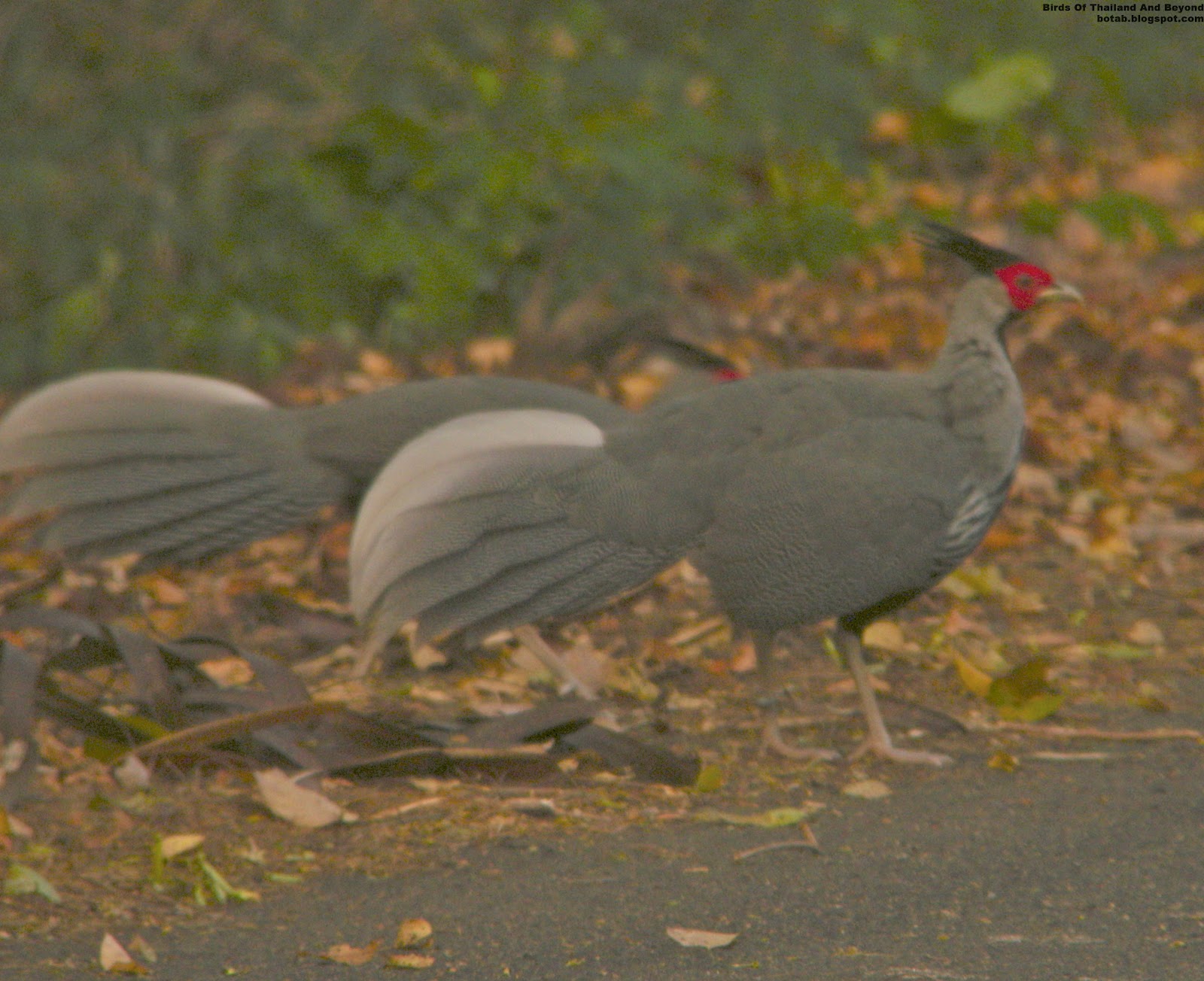
Kalij Pheasant

The recovery however is a classic example of just how wonderful the Thais can be. A passing driver, and there weren't many about yesterday as the park was very quiet plus it was late afternoon, picked me up and drove me down the mountain. Thank God he did because otherwise I might be still up that mountain! Park officials hardly raised an eyebrow when advised of my predicament. They said there was no problem removing the truck in the morning. The driver was taking a small group back to their resort  so we went there first. Next to a garage in Kaeng Krachan village where a mechanic said he would collect my truck in the morning and fix it. He too was unfazed about heading up the mountain and bringing the vehicle down. The classic British line : "This is going to cost you" accompanied by a gleeful smile and greedy, rubbing hands, didn't materialise! The mechanic estimated between six and seven thousand baht in total and that includes repairs. That sounded like a good price so I left my keys with him and said I would see him tomorrow afternoon. Then the guy drove me home to Ratchaburi, about 100 km away. Does it get better than this? If so, pray tell. Now I haven't got the truck back so perhaps I'd better be a little circumspect with the praise until then.

Kalij Pheasant - female

An annoying end to an otherwise great day's birding. This was to mark my first day on holiday after a long, tiring and demanding academic year. I felt I deserved a treat! I have said before that I don't visit Kaeng Krachan often enough and notwithstanding today's problems I must do so more often as the quality of birding is of the highest order. My first species of the day, a few kilometres after entering the park, was a Grey-headed Canary Flycatcher a really cracking looking bird. Next up in the same area came an Asian Brown Flycatcher and a Common Tailorbird. This latter immediately posed a question: could the tailorbird be a Dark-throated? This one definitely wasn't as there was no evidence of a dark throat, funnily enough, but it made me mindful especially as one that might be flew into the understory. It had dark central streaking in the throat area. So I had a quick study of the field guide and decided that to claim it I needed the dark throat and the absence of the Common's supercilium. So I couldn't claim this one as I hadn't been able to resolve the supercilium issue.


Kalij Pheasant - male


As I drove around a corner at the 5 km marker I noticed four large pheasants on the road. I managed to stop without scaring them and reckoned these were Silver Pheasants, a foursome of two males and two females. I even managed some shots in very poor light. No Silver Pheasant, no lifer. These confirm Kalij Pheasant, of the lineata crawfordii sub-species. (Thanks to Steve Pryor from Birdforum for clarifying this; he also advised that there is some contention about how Silver and Kalij and their sub-species are split. ) So looks like I am still going to have to go to Chiang Dao in pursuit of Neil Lawton's Silver Pheasant! 


Dollarbird


I deliberately took my time and drove slowly stopping all the time to check birds. A lot of the more common species but great fun and it appeared that I had the lower reaches of the park to myself. There were a few  White-rumped Shamas  and lots of Orioles flying around.  I stopped to view a female Sambar standing near a bridge, a first and also the first time I have seen a large mammal in the park. She didn't let me get the digiscope on her. As soon as she sensed movement she turned back into the forest. At the same bridge I managed to claim lifer ♯313, Dark-throated Tailorbird: unmistakable dark streaking on its throat and no supercilium. An Emerald Dove briefly showed for a drink of water and a Sultan Tit was nearby too but wouldn't sit still for the photograph!  


I noticed a lot of bulbul species: Streak-eared Bulbul, Black-crested Bulbul, Stripe-throated Bulbul and Ochraceous Bulbul. It's been some time since I last saw Ochraceous so I needed to study the field guide  to call it. I was thinking it might be a babbler species with its crest and white beard but it was really all wrong. There were more than a few unidentified species including warblers. That's the nature of birding as the little creatures flash past. A Dollarbird posed for me high up in a dead tree.

Yellow  Grey Wagtail
(Thanks to Pete Kinsella for the correction)

I made it after about two and half hours to Ban Krang camp which was always my plan: stay low and concentrate on the action before reaching the high ground. On arrival at Ban Krang a Pied Hornbill was showing well in the trees at the rear but otherwise there wasn't much of note. I drove along the track to to the rising ground, just past the third stream and all I could muster was a Green Magpie and some Black-naped Monarchs. I decided it was time to have a snooze as I was feeling quite tired.

Lesser Racket-tailed Drongo

An hour or so later I traversed the lower ground and caught a glimpse of some pheasants but they scarpered pretty quickly into the undergrowth. Then something quite amazing happened. A truck pulled up out of which emerged four birders, including two Taiwanese birders who I met the last time I was here in May 2011. We shook hands because we remembered each other. Last time these guys put us on Black-backed Kingfisher; this year they were in pursuit of Banded Kingfisher. Sure enough on their arrival the birds came out. First a small wave of approximately five  Silver-breasted Broadbill,, lifer ♯314. Now these are stunning beautiful birds, looking as if they were designed by cartoon artists.

I bade farewell to my Taiwanese friends saying I would see them next year! No sooner had they gone than I got views of a Brown Hornbill, lifer ♯315, at a nest in a hollow in a tree. I presume it was feeding but I can't be sure as I didn't see any sign of a chick. A Lesser Racket-tailed Drongo posed for me. Then high in the canopy I observed a woodpecker, all green with what appeared to be a fluorescent yellow crest. A new species, a Yellownape. However I can't make any claims as it might be Greater or Lesser; it didn't hang around long enough for me to check out any more detail. Its yellow nape was the key feature that stood out.....it really was glowing. I would say that on size it was probably a Greater. In much the same way as with Dark-sided Tailorbird, I'll need to wait until I see it again: then I'll know what I am looking for.

So I thought to myself: I am going to go for it, I am going to go up that mountain and I am going to find the Long-tailed Broadbills. Sadly it was not to be. I did however manage to observe Fork-tailed Swift, lifer ♯316. This was a large swift, really obvious long wings, with a clearly visible fork tail and if it is not Fork-tailed then I cannot see what it else it could be. The alternative would be Dark-rumped described by Lekagul and Round, A Guide to the Birds of Thailand, as a "very rare winter visitor; little known." There was a small group of 7 or 8 of these birds mixed up with other smaller swifts so I am pretty confident in this claim.

I took some shots but I have to say, and I have said this before, forests are far from ideal for digiscoping. I think a good DSLR or 4/3 camera with a 400 mm lens would be the best solution in such a habitat. Light is constantly an issue in that it is rarely adequate, plus the birds do tend to be on the move so an ability to change settings rapidly is important. Digiscoping doesn't really allow this. Sure you can change settings but it takes more time to get the bird in the viewfinder and get focus: take more time to adjust settings and the likelihood is the bird will have flown! I'll post the better shots when I have some time.

Another excellent day's birding and while I am disappointed about the truck I'll be philosophical and be grateful that I am unscathed, notwithstanding my rashness.

Saturday, 3 March 2012

The Early Bird: Black-headed Ibis at Wat Khao Takhrao


I managed an early start this morning and made it to Wat Khao Takhrao in Phetchburi province before first light. What a hive of bird activity! I have never seen such a variety and number of birds scattered all over the pond. The highlights were six Black-headed Ibis and eight Otters, species unknown - the latter were having a blast and rather frustratingly took off at my arrival and ran into the ibises causing them to take to the air. I managed a couple of shots of the Ibises - in all likelihood there were probably more than six as they were on the move, but six represents my maximum count at one given moment with three on the ground and three flying in to join them. The ducks were too far away to really identify anything other than male Garganeys. Nothing stood out on size, like Comb Duck or Ruddy Shelduck. There were more waders than I have ever seen here and in particular huge numbers of Black-tailed Godwits. And setting the scene were lots of screeching Caspian Terns. There was one unidentified raptor, with a rather thin long body and a suggestion of lighter uppers, but I couldn't identify it and won't be able to. Unfortunately I could only manage an hour or so as I had some business to attend to. But great to be on holiday and out early looking at great birds.