Monday, 10 September 2012

Reservoir: Weekend Notes

River Lapwing

Over the weekend I made two visits to Huay Mai Teng Reservoir. There is nothing quite like patch birding; hard to explain really. I saw everything that I expected to see. I was also on the look out for Little Stint. During the week Phil Round had advised me that he had received a record from Tak, several hundred kilometres north of here, also inland, of Little Stint and it made perfect sense that they might alight at the reservoir on their journey south. No stint species whatsoever on either day this weekend, but good to be aware of the possibility of a rare wader by Thai standards.

Small Pratincole 


There were five Pacific Golden Plovers on Saturday afternoon, a patch first, and following last week's Whimbrel, clear evidence that migratory waders are making pit stops at the reservoir. In addition the presence of three River Lapwing was very pleasing. There were also big numbers, at least 50, of Small Pratincoles. I was pleased to note a first, solitary Brown Shrike of the season and the distant call of a Chinese Francolin. Add in lots of Yellow Wagtails, Zitting Cisticolas, Little Ringed Plover, Lesser Whistling Ducks, Little Egrets, Openbills, Little Cormorants and a solitary Pied Kingfisher. A few buttonquails flashed out of the undergrowth but too quick for me.


Pipit sp

I rather fancy there were Richard's Pipits as they did appear to have bigger bills and their movements appeared to be different from the usual Paddyfield Pipits.  They proved difficult to photograph and most importantly they were reluctant to close their bills! This one, photographed above, also appears to have a very upright stance; however the bill doesn't appear to be very stout. The darker upper bill and the yellowish lower also supports Richard's.......I don't know! Maybe Birdforum can help! ( 12.09.12: the  Birdforum gurus are unanimous is declaring this to be a Paddyfield Pipit. There's now a good thread on Birdforum with useful comment and an excellent link to a very authoritative summary by Dave Bakewell.)

Great Egret

Early Sunday morning the reservoir was at its most serene. Warm and sunny. I was struck by an aerial cluster of 250-300 Oriental Pratincoles; these birds usually assemble here around this time and I expect their number will increase over the next few weeks. There were lots of Small Pratincoles too, between 80 -100. I set up the hide and managed to get a few shots of some of the more common birds. On my way out I flushed 3 Rain Quail and some other buttonquail species which once again were too quick for me. However I now have a definite marker and will be back to explore this in future.

Small Pratincole - juvenile
Common Sandpiper
Wood Sandpiper


Sunday, 2 September 2012

Back to the Patch

Small Pratincoles

What a joy to be out birding on my local patch at Huay Mai Teng Reservoir. A recent request for records drew my attention to not having visited the site for over a month. Tut,tut! So Benedict and I headed out in the afternoon. The water level is as low as I have ever seen it. Two stand out records: a Whimbrel, a first for the patch, and amazing to see it so far away form the sea;  and the presence of about 50 Small Pratincoles, mainly juveniles, which look as if they are "over-summering'. I say this as in previous years I have no records of Small Pratincoles from September to the end of December. There were also two River Lapwing present.

The amount of land reclamation going on is unprecedented. The topography is changing fast and most importantly bird habitat is being reduced. Half a small forest has disappeared and it looks as if the foundations are  being laid for new buildings. Electricity pylons have been erected and roads, gravel tracks at present, are also under construction. I have seen Yellow-rumped Flycatcher in this area and Nick Upton has reported hearing Siberian Rubythroat there too.

However just good to be out on the patch, looking for my own birds.

Laem Pak Bia

Pallas's Grasshopper Warbler

A thoroughly enjoyable day in Laem Pak Bia. My Saturday class was cancelled which freed me to join Phil Round and his team for a morning of bird ringing at The King's Project. There can obviously be no other way of getting so close to birds as having them in your hand! It really is great experience for a novice like myself and it is particularily good to connect so directly with the science of ornithology. The highlights today were 5 Yellow-rumped Flycatchers and 2 Pallas's Grasshopper Warblers. I banded a number of Baya Weavers, Asian Pied Starlings, and Collared Kingfishers. I have to say I felt much more comfortable handling the birds this time. The most difficult part of the whole process is removing the birds from the mist nets. They do get tangled up. However it becomes easier with practise and more importantly the bird can be removed much more quickly.

Cinnamon Bittern - female

We ringed 50 + birds today and recorded simple vital statistics for the more common species: weight and the  length of the leading wing. A much more detailed analysis is made of the Warblers and Flycatchers including the removal of feathers for possible DNA analysis. Phil keeps a large database of all ringed birds; retraps and recoveries combined with sharing information with other ringers enable field biologists to provide answers to some of the many questions we have about birds.

I need to say that in all of this the welfare of the birds is of the utmost importance. The objective is to get the birds out of the nets, processed and released as quickly as possible. It was therefore sad to see a dog attacking a pond heron in one of the beds. I hasten to add this was not a trapped bird. I was having a wander around after we had finished ringing and the hound was in one of the grass beds and had managed to disable the bird so it could not fly. I scared it off but I rather fancy that having disabled the bird it went back later to finish off the job.

Immediately prior to this I managed to photograph this Cinnamon Bittern but it too took off when the dog appeared on the scene. I think it is a female, a beautiful bird and it becomes even more beautiful when it elongates its neck. There are a lot of good birds in and around the Kings Project.

Mid-afternoon we had a spin aroud Laem Pak Bia. We chanced upon a flock of approximately 1,200 Great Knot which according to Phi is unusual so early; we could make out a solitary Red Knot in this flock. In or nearby we counted about 450 Whimbrel, 30 Bar-tailed Godwit, 11 Terek Sandpiper, 1 Asian Dowitcher, 1 Milky Stork, 2 Spot-billed Pelicans.....Laem Pak Bia is starting to happen.

The only bummer was we failed to see either the Great Thick-knee or the Indian which have been reported recently. However little to be down about, a truly memorable day.


Sunday, 26 August 2012

Balenoptera Edeni: Bryde's Whales in the Gulf Of Thailand

Bryde's Whales, Bang Tabun, Gulf of Thailand

My phone call last week to Phil Round about the mystery wader was rather fortuitous. Phil kindly extended an invitation to join his family and friends whale watching in Bang Taboon bay, to the north of Pak Thale. I needed little encouragement.


So this morning out into the watery world we went at 08:30h and after three reasonably uneventful hours we finally located the leviathans in the Meklong area. To be precise 4 Bryde's Whales and they put on an excellent show for us. I have only ever seen a dead whale back in the early 1970s beached on the island of South Uist in Scotland's Outer Hebrides; what I recall is the size and stench. These whales were simply majestic making themselves visible by opening their mouths at right angles and keeping the lower half in the water; apparently they can filter out the water, retain the fish, and then swallow. It was impossible to digiscope and the above is my best effort on a boat that was really swaying; I think you can see a mother and calf with their mouths open for feeding. Notice the commensalism with a tern to the left hoping to scavenge some of the small fish which you can see in mum's mouth: I learned that word from teaching G9 science earlier this year! Indeed the whales attract White-Winged Black Terns of which there were plenty and we also spotted a couple of Bridled Terns too.

In the end I gave up trying to get a digiscoped image and got a couple of shots of the whales using 14-45mm MFT zoom, probably equivalent 35 mm DSLR of about 100 mm. In real terms I was happy to watch the spectacle. What truly beautiful, graceful creatures. The couple of Irrawaddy dolphins we saw on our way out seemed insignificant and the birds, too, were almost secondary: in the region of 70 Great Crested Tern, 20 + Great Cormorants, abundant Whiskered, White-winged Black and Common Terns and a migratory Grey Wagtail.

Click on this link Bryde's Whale for a very helpful summary of information about Balenoptera Edeni.

Sunday, 19 August 2012

A Very Wet Afternoon in Laem Pak Bia

Great Egret

Torrential rain meant my efforts to locate the Great Thick-knee at the Abandoned Building area in Laem Pak Bia were unsuccessful. The problem was the volume of surface water on the dirt tracks and I had to get my truck onto a sealed surface to avoid getting stuck or worse. It really was no fun and at various points my truck was effectively out of control; fortunately the terrain is flat here but on a sloping surface this might have been deadly. I did learn from some birders that the bird had been seen in morning. I am in the privileged position of having seen the Great Thick-knee in each of the last two years but a couple of friends are itching to add this species to their lists and are actively contemplating a long distance twitch. In view of this I would have liked to confirm a positive sighting.


So the weather was the story today. Not surprising really. This is the rainy season and it does tend to hammer down, often in short bursts. The only real problem tends to be the effect on unsealed roads of which there are many. Later in the afternoon I almost got stuck at the King's Project as my tyres were struggling to get traction.

Common Redshank juv
With grateful thanks to Dave Gandy & Phil Round for the ID

The good news is there were plenty of waders and in amongst all the usual suspects I was pleased to note Pacific Golden Plovers and Grey Plovers. There were also good numbers of Black-tailed Godwits and Curlews and a fair few Whimbrel too; add in some Greenshanks and Marsh Sandpipers. I didn't see anything unusual but observation conditions weren't so good but I did scan the godwits and curlews for  black bills; unfortunately most of the birds were a distance away and they were roosting with their bills tucked away so pretty difficult to make anything out.

Greater Painted Snipe

There were 7-8 Spot-billed Pelicans two of which I managed to photograph. I am pleased with the shot as they were about 80 yards away and the light was poor. I was also pleased to get all of the Great Egret in the frame and could only have wished for better light to do this elegant bird justice.

I must confess to struggling with the ID of the "tringa". It's those reddish legs that have thrown me. I would expect some red on the bill for one of the Redshank species and on consideration I would expect the legs to be a much richer red. I would say Wood Sandpiper. In Shorebirds ( Hayman et al.)  Woodsandpiper legs are described as "...dull yellowish, usually greenish or brownish-yellow, always looking pale at a distance." That possibly solves the leg issue and of course the bill is undoubtedly that of a Woodsandpiper: once more Shorebirds notes "...a blackish distal half and an olive-green or yellow-green base." I have just learned what "distal" means: furthest away from the centre of the body. So I would say Wood Sand. Of course I would appreciate confirmation or correction.

Update: Dave Sargeant suggests a female Ruff as the reddish legs for a Wood Sandpiper are "off"; looking at the bill which I now see has some decurving, I think he might be right!  Tom Backlund is of the view it is a Wood Sand as "...the bill and legs are way too long..". Dave Gandy thinks it is a juvenile Redshank and he's sure! Fascinating stuff. Well I had to seek Phil Round's opinion because I don't know what it is. From Phil: "Dave Gandy has it right!! It is a juvenile Common Redshank. The legs are far too orange for a Wood Sandpiper. Enough of the back can be seen to show the even upperparts spotting typical of juvenile Tringa. The dull purplish-flesh (no red) to both mandibles indicate juvenile Common Redshank. Also, we already know that we get a massive wave of juv Common Redshanks passing through LPB in mid-August." I am very happy to get this sorted out. Thanks to all for their help and contributions. This process underlines what a complex and challenging task bird identification can be.

The Greater Painted Snipe knew I was near and refused to come out and pose. I'll need to develop my Photoshop skills in order to learn how to remove the strands of grass which are disguising this truly beautiful bird. I have moved one strand which crossed its bill but the others will require a much more precise procedure which I haven't learned yet!

Monday, 13 August 2012

Wat Khao Takrhao & Laem Pak Bia

Milky Stork

Benedict and I headed off to Phetchburi province this afternoon for a look at Wat Khao Takhrao and thereafter onto Laem Pak Bia to coincide with high tide. I do hope I can start many more blogs with this introduction! It was fantastic to be out birding again and it was great to have Benny with me.

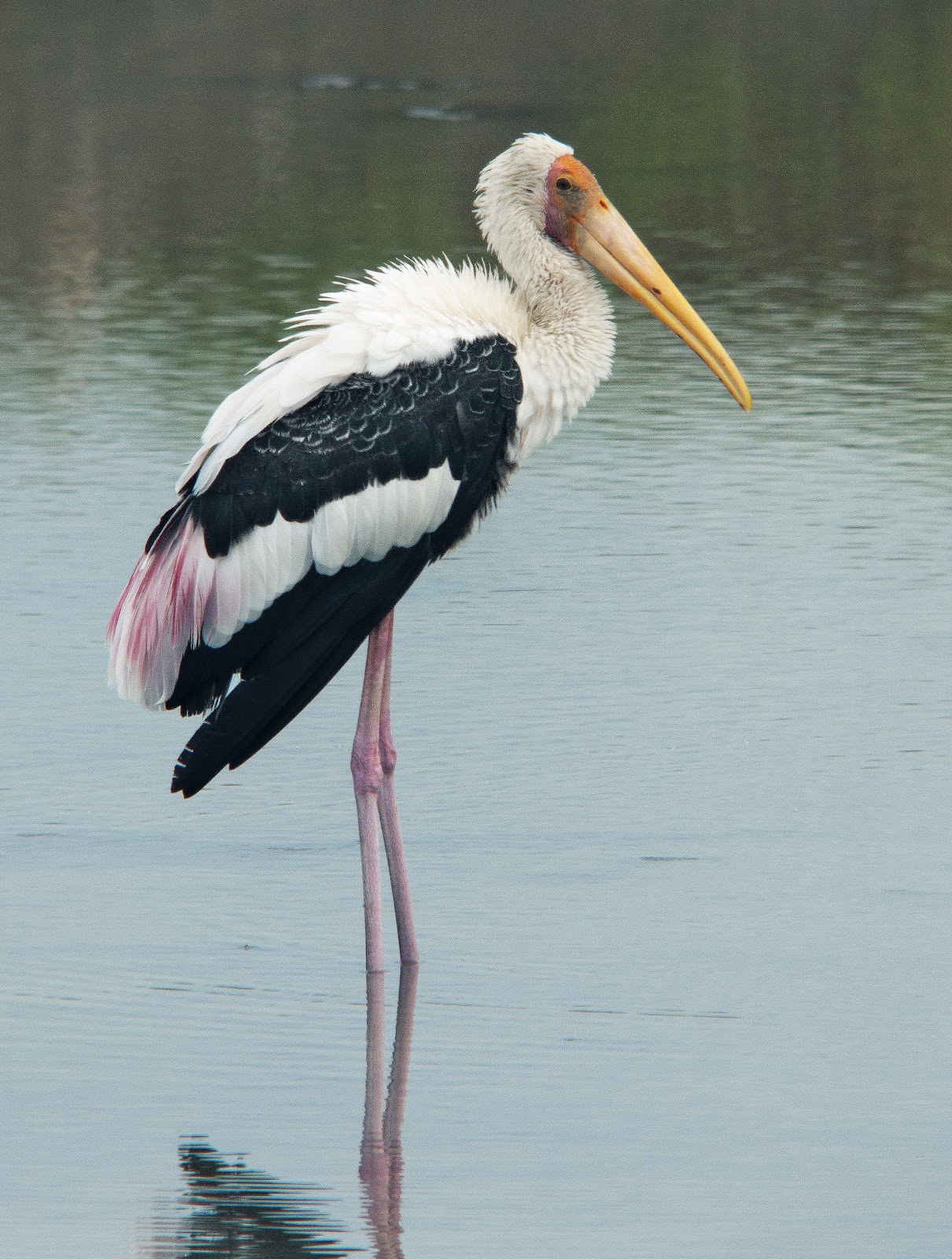
There was little to suggest that we were going to run into anything interesting. The drive through Khao Yoi was unremarkable. We saw a small flock of Painted Stork as we drove through the swamp to Wat Khao Takrhao. At Wat Khao Takrhao I was prepared for a good number of Painted Stork and some Spot-billed Pelicans and I was hoping there might be some sign of Great Thick-knee.

The story however was Painted Stork, in their thousands. Impossible to count: there was a huge central core of about 1,200 birds in the middle area of the big pool and then there were smaller groups scattered everywhere. A scan revealed a pair of Spot-billed Pelicans and then Black-headed Ibis, 16 of them: quite unexpected I hasten to add. There were also a handful of Whiskered Terns and 50-60 Lesser Whistling Ducks. In terms of waders there were good numbers of Black-tailed Godwits, some Common Greenshanks, Marsh Sandpipers and Wood Sandpipers.

Asian Dowitcher

As we headed towards the temple I noticed some Godwits in one of the many pools and at this time of the year, with waders on the move, you dismiss them as a group of Black-tailed Godwits at your peril. I got a glimpse of a long, black bill with my bins and then of an incredibly strong whiter supercilium; I had the scope up in no time and all I knew was that it was neither Black-tailed nor Bar-tailed on the basis of the bill colour. I was hoping it would be a Long-billed Dowicher but that is just because I want lifers. Of course I didn't have a field guide with me so I had to get some shots of it. A call to Tom Backlund confirmed the likelihood of it being Asian. I think the photo confirms it is indeed Asian. I wonder where this fellow has come form and I wonder where his journey will end. While I took the shot Benny did splendid work in advising the oncoming traffic to be quiet!

We then drove to Pak Thale which rather surprisingly was as good as bird-free; I must confess it is almost virtually water-free right now as most of the salt pans are empty. Strange not being able to see a Curlew or a Lesser Sand-plover. No doubt it is going to get very busy here over the next few months.

We then headed down to Laem Pak Bia. Given the near dearth of birds at Pak Thale I thought they must all be down here. Five Spot-billed Pelicans and a small group of Painted Stork and little else other than some Redshanks. Except there was a Milky Stork in the among the Painted Stork. Now this bird has been around for a few weeks so I was really pleased to connect with it and I managed to get a few shots of it.

The Milky Stork is a pretty rare bird and in fact has an IUCN rating of Vulnerable. Its numbers are in decline with its stronghold in Sumatra, Indonesia. It pops up here infrequently usually in solitary numbers, tending to associate with flocks of Painted Stork. As you can see it could easily be confused with Painted Stork. The most obvious difference is the Milky does not have any pink feathering and the visible black feathers are restricted to the outer fringes of the wings when the bird is standing; the bill colour is different, a yellow pink whereas the Painted is orange, reminiscent of Cheddar cheese. I also rather fancy the Milky has a head fringe which appears to be lacking in the Painted; what I mean is the feathers extend more onto the Milky's forehead.

No sign of Great Thick-knees and not a lot else but a great afternoon and a great selection of birds.


Sunday, 12 August 2012

Digiscoping and Post-production

The last two weeks have been difficult and challenging. When I should have been doing a lot of birding I have in fact been either too worn out or sick. We have had two consecutive long weekends. Last weekend exhaustion took hold of me and we scrubbed our scheduled trip to the wilds of Kanchanaburi province. It was the right thing to do as I needed the rest. This week I have been laid low by a severe case of the trots and it is only in the last 24 hours that I am getting back to normal. In the great scheme of things, fairly high class problems!

Long-toed Stint - unprocessed

Long-toed Stint - processed by Peter Ericsson

A week or so ago I was talking to Peter Ericsson about my images. Peter needs no real introduction as he is one of the best bird photographers in these parts. He told me he thought I should definitely be getting sharper images and he took one of my images and put it through Photoshop and in effect proved his point that "no image is done until it has been processed in PS". Peter's produced a tutorial which includes a basic PS treatment: it can be found here. Well the difference is very striking if you take a cursory look at the above two images.

So it's perhaps just as well that I have been out of sorts as it has enabled me to start learning how to harness the power of Photoshop. I have managed to get some instructional material and I am working leisurely through this. The Painted Storks below are in fact the same file but the first one has been processed using PS. I have also cropped it so it is not quite like for like but post-production has really transformed the image.


I am also very pleased with this picture of a Great Knot dating back to February at Pak Thale. The PS processed image, with some cropping, comes first and the original follows. It really is a no brainer!


So it's good to get started finally on post-production and Photoshop. Up to now I have done most of my post-production in Aperture. It's pretty simple and offers a very effective solution for image management. Photoshop is very different however and I am very aware of really just dipping my toe into the water, so to speak.

My indisposition also lead to me purchasing a 2 TB external drive and I am going to try and archive my images. Good as this may sound, I reckon I am going to be deleting an enormous number of image files. However I am going to try to get through them because there are some images which I can improve with some post-production.

On reflection I think I have been lazy. I should have made more of an effort with Photoshop. However it is not a load it up and play it sort of programme. It needs effort. I think I have also been guilty of accepting inferior results. Digiscoping allows for many mitigating factors!

So let me thank Peter for pointing me in this direction and I hope to get out birding in the very near future.