
botab's new home: botabblog.wordpress.com
Sunday, 30 January 2011
A Dead Barn Owl
Not much to write about as I have been in Bangkok the last three days on a training course. Some sad news. Friday morning I saw an injured Barn Owl at 06:15 am near the bins (trash, garbage) not far from our house. Dark but I caught the owl in my headlights on the ground and it moved rapidly away when it became aware of my presence. I could see the owl couldn't fly and it headed into the scrub. I have never held an owl, wouldn't know how to and in fact all I know is it could hurt your hands and arms, plus I have nowhere to put it if I could have safely got it under my control. So I decided there was little I could do there and then other than leave it and hope. On return home I searched but couldn't find it and thought maybe it had managed to get away. Saturday morning I searched again but no sign but in the evening, on my return from Bangkok, a dead owl was lying on the street and its carcass had been flattened by vehicles. I presume the soi dogs had got it and killed it. Maybe not. Maybe humans had killed it. The locals regard owls as harbingers of death and so owls are persecuted and the more common species such as the Barn Owl, can often be found in temples' grounds where the Buddhist mantra on not killing any life form applies. Maybe this owl had simply keeled over, tired and exhausted.... I was sad that I hadn't been able to do more for this bird. I also notice that our Red-collared Dove has abandoned its nest. I wonder what has happened. It's not always about appreciating the sublime beauty of these creatures...... I think I better get a cage and learn how to handle raptors and birds of prey.


Wednesday, 26 January 2011
Local Birds


Plaintive Cuckoo - Female Hepatic Morph Variant (?)
Ratchaburi 25.01.11
I headed home with the sole objective of getting out for an hour of good light to photograph some of the local birds that are in the rice paddy at present. For instance last night I thought I could distinguish Paddyfield and Richard's Pipit, there were Red-throated Pipits, Yellow Wagtails, Sparrows and lots of Pied Starlings, Common Mynas and Cattle Egrets in hundreds. I did not bring my camera last night so I thought they would be back tonight, you know, waiting for me, posing! Alas no. A few Black Kites, hundreds of egrets but not the same range of small birds. I was also being a bit of a dope with the camera, just missing shots and there was quite a lot of noise around me as I was in a new area and people were asking me what I was doing. Anyhow I managed a couple of shots of this female Plaintive Cuckoo and now I have looked at the field guide I reckon it is the Hepatic Morph Variant on account of the light underparts.
Tuesday, 25 January 2011
Tokyo Stopover by Brian Casatelli
All photographs in this article are © Brian Casatelli

Japanese White Eye

Oriental Greenfinch

Azure-winged Magpie
On our way back to the US form Thailand we stopped in Tokyo for a few days to visit friends and managed to squeeze in a little bird-watching. Weather conditions could hardly have been more different from Thailand; by day temperatures in Tokyo were never higher than 8º C and at night between 0-3º C. In other words it was freezing!

Brown-eared Bulbul

Northern Goshawk
Our first birding visit was a morning spent at the Meiji Shrine on 3rd January which can be easily reached by public transport. This was the last of the public holidays for the New Year and we were prepared for it being quite crowded. It was even more crowded than that! Because of the crowds, the entrances into the forest were roped off by the police who did a good job with the crowd control. There probably were other places to go in the park, but leaving the train station we found ourselves in the middle of the procession to the shrine and just went with the flow.

Common Pochard

Northern Goshawk
We saw a number of nice birds. I noticed right away that the birds were the most approachable I have ever come across (with the exception of Azure-winged Magpie which I encountered the next day). They came right up to the path unconcerned with the thousands of people marching towards the shrine right next to them. We saw Eastern Great Tit, hawfinch, the lovely Japanese white-eye (that turned out to be quite common and easy to see), oriental turtle dove, Japanese pygmy woodpecker, Brown-eared bulbul, Carrion and Large-billed crows, and what I think was a Varied Tit.

Black Kite

Brown-eared Bulbl
We wound up walking right past the shrine. It was not the 'grand' building we were expecting but was located in what we thought was the entrance to the shrine. We only realized we had passed it when we realized we were walking down the exit path. That was ok, we were ready to move on to Ueno Park to see what waterfowl were there.

White-cheeked Starling
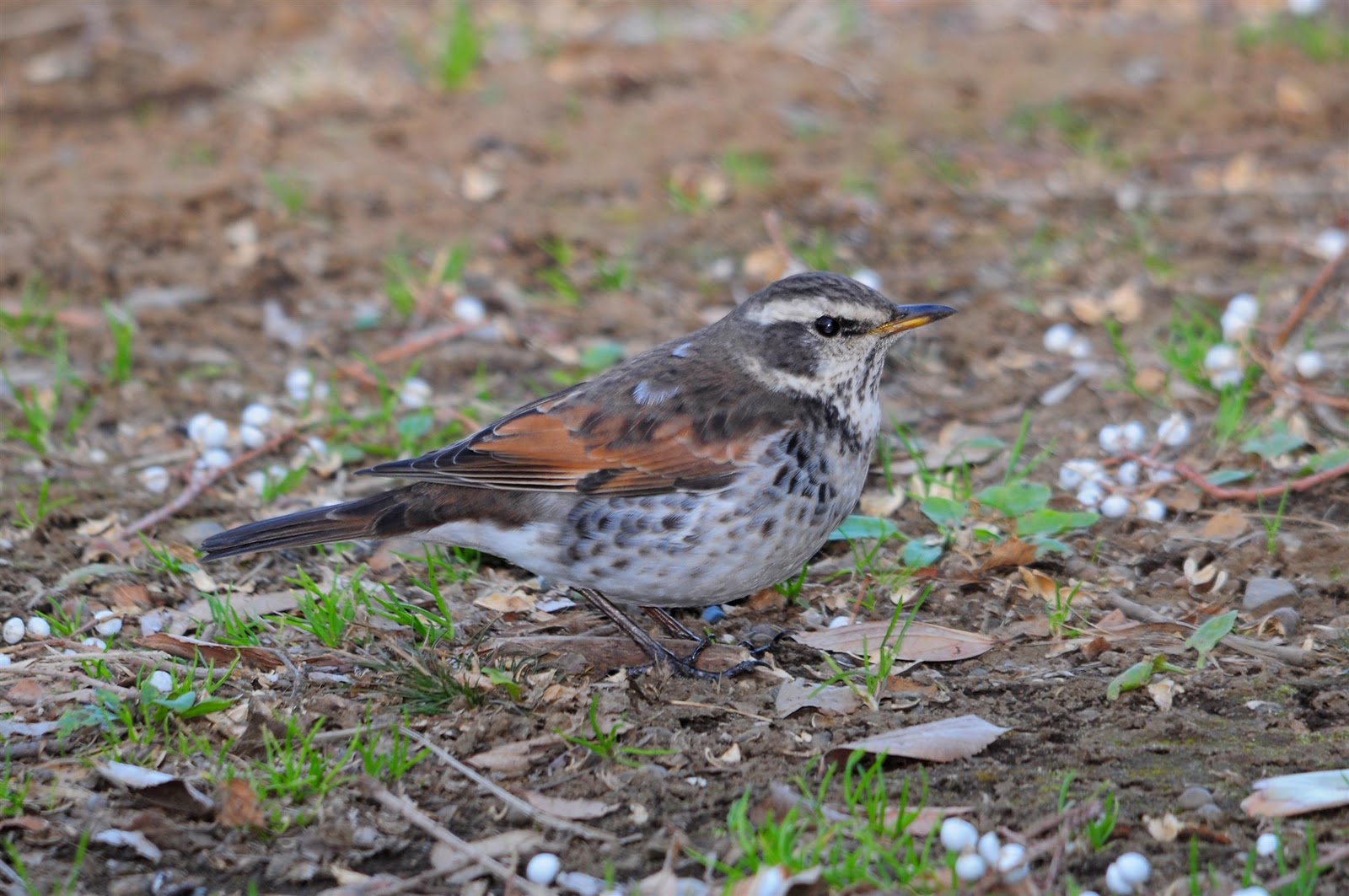
Dusky Thrush
The pond in the park is located next to the zoo and was quite nice. There we saw Black-headed, Slaty-backed, Black-tailed and one as of yet unidentified gull. We also saw Tufted duck, northern pintail, northern shoveler, common coot, little grebe, eurasion wigeon, common pochard, the two crow species, brown-eared bulbul, eurasion tree sparrow, and good old rock dove.

White Wagtail
Later in the day, we saw white wagtail on the grounds outside the Imperial Palace which we weren't able to enter because of the holiday.

Black-necked Grebe
Tuesday 4th January we squeezed in a last scheduled, morning of birding. We went to Kasai Rinkai Koen. Koen means park. It's at the top end of Tokyo bay across from Tokyo Disneyland. There is a park area and then a coast that offers a nice variety of birds to be seen. The list here included the usual suspects plus oriental greenfinch, azure-winged magpie, white-cheeked starling, spot-billed duck, great cormorant, kentish plover, common sandpiper, one unidentified "peep", greater scaup, little egret, dusky thrush, black-necked grebe, northern goshawk.

Carrion Crow
That was it for the scheduled birding, but there were some incidentals in the following days. In our jaunt to Kyoto, we saw Mallard and Grey Heron on the grounds of the Golden Temple. In Kamakura, we saw Black-eared Kite, which I am not sure is a separate species or subspecies of Black-kite. Finally on the last day before our flight home to New York, my friends father took me to a park along the coast in Yokohama. After a long freezing wait because we got there too early, we had half an hour of daylight before we had to leave and I saw one more species, and lifer: Eurasian teal.

Eastern Spot-billed Duck
People seemed mindful of conservation everywhere we went. People turned off their engines when stopped at a traffic light. Buses turned off theirs when stopped at a bus stop also.Over all the trip to Japan was great. We had a wonderful mix of local flavor, big city, train rides, great food, birding, and overall great experience. But if you decide to go, do bring some cash. It is incredibly expensive and non-Japanese credit cards don't always work. I was able to check off 15 lifers in the short trip, so I think it was a success. More information about birding in Japan in English is available here.

Eurasian Wigeon

Large-billed Crow
Note: Brian Casatelli is a New York based birder/photographer who recently visited Thailand and we shared a very enjoyable day's birding at Bueng Boraphet. He sent me some photos of his stopover in Tokyo and I am very happy to be able to publish them here. I'll happily consider any offerings for this blog in the spirit of putting birding information into the public domain.
Monday, 24 January 2011
Black Kite Bonanza

Red-throated Pipit
Ratchaburi 24.01.11
On arrival home this afternoon after school I was delighted to see Mummy Scaly-breasted Munia and Baby out of the nest and Mummy teaching Baby how to fly. I do not know about Baby 2 but there wasn't any sign of it; maybe in the nest. Upstairs in the veranda the Red-collared Dove according to our housekeeper is sitting on two eggs: I don't know how she knows this but that's what she says!

Black Kite
Ratchaburi 24.01.11
Encouraged by this activity I headed round to the rice paddy and a few moments later I was attracted by an unusual shape perched on a pole in a field. I wondered if this might be a Common Kestrel so had a look and in fact it turned out to be nothing more than a strangely shaped piece of wood! However I was immediately struck by the sight of two large birds cavorting mid-air and a few seconds later I knew these were Black Kites and a closer look revealed a further 3 kites on the ground and this fellow perched on a pole, making six kites in total.

Black Kite
Ratchaburi 24.01.11
I did something quite clever by my standards! I was still far enough away so I got set up and then drove into the rice paddy and got behind the setting sun with the bird in front of me. I managed to use my truck for cover and managed to click away from about 60 metres. I have to say I am pleased with the results. These kites are pretty common in the locale but I never tire of them.
Black Kite
Ratchaburi 24.01.11
I know nothing about the rice cultivation cycle but in recent weeks the rice has been harvested, the remnants eaten up by ducks, the remaining stalks have been burned, and now the soil has been tilled and in some places watered prior to replanting. It is therefore a feeding bonanza for birds and in among the hundred of cattle egrets, intermediate egrets and other birds was a small flock of Red-throated Pipits, 5 or 6 birds. Alas the sun had set and it was pretty gloomy so my photographs are poor. However common these Pipits may be they were lifers for me. In the same part of the paddy there was a lot of Wood Sandpiper, a few Common Sandpiper and a Spotted Redshank; I don't recall seeing a Redshank before in the local area.
So not a bid hour after work!
An Unsuccessful Twitch

Coppersmith Barbet
Kaeng Krachan 23.10.11
Wednesday, 19 January 2011
Plain-backed Sparrow: A Misnomer?

Plain-backed Sparrow
19.01.11
I have to say how much I am enjoying snatching an hour's birding here and there in my neighbourhood and being able to look more closely at the more common birds. In and around the local rice paddy there is an abundance of these plain-backed sparrows and surely no bird would be more entitled to feel resentful at being given such a misleading name. Plain it ain't! I have to say the field guide drawing doesn't really do these birds very much justice! A real beauty in fact with a degree of considerable subtlety in its plumage.
I did my bit for the kingdom of birds this morning. We found two Scaly-breasted Munia fledglings on the ground close to their nest in our pomegranate tree. I suspect there was nothing more to their presence there than an unsuccessful attempt at flying, as opposed to a predatory attack. So I picked them up and returned them to the nest. I didn't photograph them as it was still dark but they were really tiny but didn't appear too distressed by being handled. I am glad to say just before we left to go to work Mummy flew in hopefully with some breakfast for her cares. Elsewhere we have a Red-collared Dove nicely settled in a lamp holder on our upper balcony and no doubt she will produce a few fledglings in due course.
There is an amazing spectacle to behold on the local rice paddy and no doubt everywhere else in Thailand at the moment. Thousands of domestic ducks are being fattened up on the remnants of the recently harvested rice crop. There is a major increase in the demand for duck during the period of The Chinese New Year which begins on 3rd February this year. (The Chinese New Year is a big event here in Thailand and many businesses will be closed for instance.) The ducks make an amazing sight and indeed sound and sometimes there can be upwards of 10,000 ducks in one flock. I suspect their presence and particularly that of their human minders keeps away the raptors; no doubt one of the key responsibilities of the minders is to chase off birds of prey.
Tuesday, 18 January 2011
Asian Koel: Often Heard, not Always Seen!
Well here is a first venture into Video using the digiscope rig......videoscoping. The Asian Koel can be heard virtually everywhere in Thailand including the heart of Bangkok. You are more likely to have heard it than to have seen it. Anyway it posed for me on an otherwise lacklustre trip round to the local rice paddy so as I have been meaning to try video here is a first offering. The quality is not brilliant but it makes me think what would be possible with a HD camera. And below a couple of still photographs of the same fellow.


Subscribe to:
Posts (Atom)