Sunday, 1 January 2012

Happy New Year from Ratchaburi!

Red-throated Pipit
Anthus cervinus
นกเด้าดินอกแดง
Ratchaburi 01.01.12

Almost as an afterthought I decided to go birding at 1630h and headed into the local rice paddy here in Ratchaburi; literally round the corner from where we live. I took my son with me and he very obliging fell asleep! My first bird of 2012 was a Common Myna, the first bird I viewed using my bins was an Asian Pied Starling and the first and only bird I have photographed in 2012 was a Red-throated Pipit.

It was unusually quiet and overcast and in fact conditions were really against photography. I was able to drive out into the middle of the rice paddy as the ground is flat and dry and the steady flow of trucks in and out has made a decent track. I ventured on a Common Kestrel hovering, a Black-shouldered Kite and I had the good fortune to see two Pied Harriers, a male and a female, flying in tandem and immediately even my dodgy eyes could see the female as a bigger bird than the male. There were lots of Red-throated Pipits.

Not bad for an afterthought! Happy New Year once more to you all!

Saturday, 31 December 2011

Back at Don Hoi Lod

Little Heron
Butorides striata
นกยางเขียว
Don Hoi Lod, Samut Songkhram Province 
31.12.11

As has been my habit during this break I went out birding this afternoon today and once more headed to Don Hoi Lod, Samut Songkhram province, in search of more rare waders. Well none today but just a pleasure to be out again birding in pleasant conditions and, of course, lots of good birds and photo opportunities.

Pacific Golden Plover
Pluvialis fulva
นกหัวโตหลังจุดสีทอง
Don Hoi Lod, Samut Songkhram Province 
31.12.11


The Whimbrel flock, about 90 birds today but that number was swelling with arrivals, were in the same place as before and I attempted to get close. I managed to get very muddy but made it to some cover; no sooner did I point my lens than off the pack went! How inconsiderate! I did however manage to get reasonably close to a Pacific Golden Plover. There were loads of Common Redshanks about: this must be the most common species in the area.

Collared Kingfisher
Todiramphus chloris
นกกินเปี้ว
Don Hoi Lod, Samut Songkhram Province 
31.12.11


I got a look at the sea this afternoon which isn't always possible in the area as there is extensive mangrove. I had fun with this pair of Collared Kingfishers. A group of local boys were very interested in what I was doing. I became a school teacher for a few minutes and told them to be quiet! Especially when I did it in Thai! They were amazed when I showed them the images of the Kingfishers through the loupe on my LCD. In turn I was amazed when they told me it was a "pee-u"; these kids actually knew its name. "Pee-u" is its Thai name from "nok-geen-pee-u"(นกกินเปี้ยว) and that translates as something like "the bird that eats a type of crab", (viz, the fiddler crab or Ocypodidae uca dussumieri ).

They loved the Little Heron as much as I did and they also obeyed my entreaties once more to be be quiet and this time to sit still as I went in to take the shot. Fortunately the Little Heron was completely focused on its next meal: this meant it was very still. The boys called the bird a "punk"!

Greater Sand-plover
Charadrius leschenaultii
นกหัวโตทรยาใหญ่
Don Hoi Lod, Samut Songkhram Province 
31.12.11

I then headed back to my happy hunting ground but this time no big surprises. Lots of plovers, huge numbers of Common Redshanks, many Marsh Sandpipers, a small flock of Brown-headed Gulls, some Common Greenshanks and a fair few Black-tailed Godwits. But none of them came in close today!

So folks, that's it for 2011. Let me wish you and yours a very Happy New Year. May it continue throughout the year and most of all enjoy your birding.

Friday, 30 December 2011

Somewhere West of Samut Songkhram......

Cotton Pygmy-goose
Nettapus coromandelianus
เป็ดคับแค
Samut Songkhram Province
30.12.11

I am not really sure how to describe where I went birding this afternoon but as I have said  many times before, it warrants further investigation. Basically I head to the area west of Samut Songkram and south of the Rama II highway, about 10 kilometres before you reach Wang Manao. My target destination was Klong Khon, to check out the mangrove, but I never made it. But once more I had a great couple of hours' birding.
Cotton Pygmy-goose
Nettapus coromandelianus
เป็ดคับแค
Samut Songkhram Province
30.12.11


I arrived at a large fish pond which had good numbers of Cotton Pygmy-Goose ( 125-150), Lesser Whistling Duck and Little Grebe; there were also a few Common Moorhen. A scan for more waterfowl, more exotic ducks, drew a blank. However Cotton Pygmy to my mind is a splendid bird and it's been a good few months, perhaps even a year, since I last saw one.

Egrets
Samut Songkhram Province
30.12.11

In the adjacent pond, overgrown and grassy, surrounded and almost hidden by shrubbery, there was a veritable cornucopia of jacanas: both Bronze-winged Jacana and Pheasant-tailed JAcana, the latter looking quite ordinary minus its resplendent breeding plumes; there were plenty of juvs. too.  Just too far away to photograph.

Egrets
Samut Songkhram Province
30.12.11


A few kilometres further on I chanced up 12 Grey-headed Lapwing, once more too far away to photograph but lovely to observe as they lounged in the sun. Further on I chanced upon the largest concentration of egrets I have ever seen - a truly impressive sight. I think the safety-in-numbers rule must have applied because only those egrets closest to me moved. There is one solitary Grey Heron in the pack.

Egrets
Samut Songkhram Province
30.12.11


A small kettle of aboout 30 Black Kites hovered above the egrets for a few minutes before proceeding south, presumably to the Khao Yoi roost.  A few of these even came right down and flew between the two columns of egrets.

Black Kite
Milvus migrans
เหยี่ยวดำ
Samut Songkhram Province
30.12.11


The kites offered some photographic opportunities but I am still not happy with the results. These shots are definite improvements. However I think I now know what to do: boost the ISO to 400 or higher  so I can shoot at 1/1000 sec. I am going to try this next time I get the opportunity and the light to shoot birds in the air.

Black Kite
Milvus migrans
เหยี่ยวดำ
Samut Songkhram Province
30.12.11


So I never made it to my intended destination but another fun afternoon. I am happy looking at and photographing birds, the only requirement really being that the birds are wild. I continue to be amazed by the variety of birds within one hour from home and am really glad that I have decided to stay local over these last few days.

Lesser Whistling Duck
Dendrocygna javanica
เป็ดแดง
Samut Songkhram Province
30.12.11


Let me wish you all a very Happy New Year and express the hope that 2012 is a great birding year for you wherever you may be. Bonne Année! Blianadh Bha Ar! ( blee-an-ah-va- aar - the Scots were always a difficult bunch!) โชกดีปีใหม่นะครับ (chok-dee-bee-mai-na-krup).

Whiskered Tern
Childonias hybridus
นกนางนวลแกลบเกราขาว
Samut Songkhram Province
30.12.11

Thursday, 29 December 2011

Asian Dowitcher at Samut Songkhram

Asian Dowitcher
Limnodromus semipalmatus
นกซ่อมทะเลอกแง
Don Hoi Lod, Samut Songkhram
29.12.11

I was a dutiful husband this morning and changed a tap in our kitchen which has been making a terrible racket for the last few months. What I thought would take 20 minutes turned into a 4 hour job so no birding today until this afternoon. So back I went to the salt pans near Don Hoi Lot, Samut Songkhram province to test my assertion that this area would be worth further investigation.

Common Redshank 
Tringa totanus
นกทะเลขาแดงธรรมดา
Don Hoi Lod, Samut Songkhram
29.12.11


I had a lot of fun observing and photographing the more common species: common redshank, brown-headed gull, little egret. There were a few raptors on the scene : a Brahminy Kite buzzing the gulls, a pair of Pied Harriers, female and juvenile, equally struck terror into the gulls just by flying over and a scruff bag Osprey flew over a couple of times. There were significant numbers of Greenshanks and Marsh Sandpipers, a couple of Little Heron, a Common Kingfisher flew low over the water and lots of egrets and Whiskered Terns. There were a few Caspian terns also for good measure. Conditions were well-nigh perfect: a gentle breeze mitigating the heat of a strong sun.

Gull-billed Tern
Gelochelidion nilotica
นกนางนวลแกลบปากหนา
Don Hoi Lod, Samut Songkhram
29.12.11


I also made the bird below a Black-headed Gull but the Birdforum gurus reckon it is a Brown-headed  Gull.I simply don't have the knowledge or experience in these matters. I was persuaded mainly by the dark iris; the Brown-headed has a noticeably lighter iris. If you want to offer an opinion please do so! I am not interested in controversy, let me stress, I just want to better my identification skills!


Brown-headed Gull
Larus brunnicephalus
นกนางนวลธรรมดา
Don Hoi Lod, Samut Songkhram
29.12.11


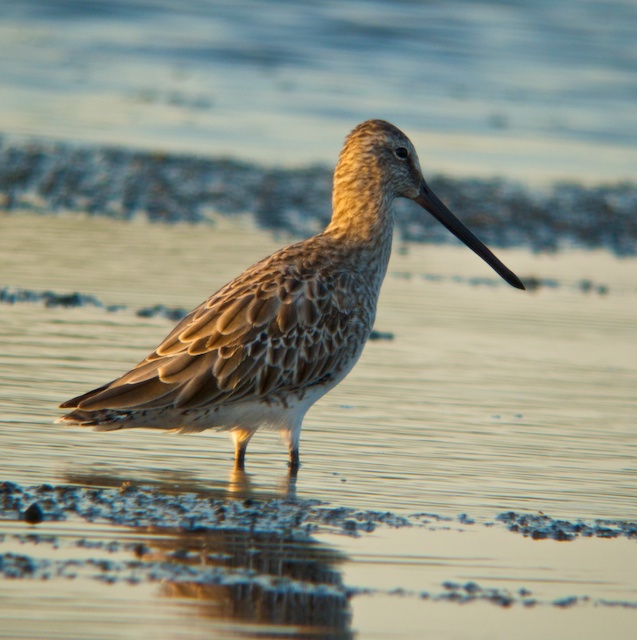
I decided late afternoon to head out into the saltpans and try to get some shot of a flock of Brown-headed Gulls. I made it to a shelter which was still a bit too far away from the gulls. There was a Gull-billed Tern within range and then a steady flow of Marsh Sandpipers and Greenshanks started to arrive in the pond nearest to my position. At about 1740h I noticed the arrival of what I thought was a Godwit and in my idle sort of way I thought I should get a shot of it and check out if it was Bar-tailed or Black-tailed. I knew immediately it was a dowitcher when I got the bird in my viewfinder - a distinct black, straight bill. For purely selfish reasons, ie my list, I rather hoped it would be a Long-billed Dowitcher but I thought it was more likely to be Asian Dowitcher. My maestro Tom Backlund has confirmed the ID as Asian.

Marsh Sandpiper
Tringa stagnatilis
นกซายเลนปึง
Don Hoi Lod, Samut Songkhram
29.12.11


I first saw Asian Dowitcher on the intertidal mudflats at Koh Libong, near Krabi in the south of Thailand, almost two years ago, so no lifer.  This time, however, it was much, much nearer and because of this the shot is about 100 times better! 

Common Greenshank
Tringa nebularia
นกทาะลขาเขียว
Don Hoi Lod, Samut Songkhram
29.12.11


The Asian Dowitcher turned a pleasant afternoon into a memorable one. I did not realise the Asian is a much more threatened species than Long-billed; it may simply be in Thailand that the Long-billed is much rarer. But globally the Asian has an IUCN Red List status of 'Near Threatened' and numbers are estimated to be approx 23,000, (BirdLife International). I also did not realise that Don Hoi Lot is a Ramsar site on account of the large numbers of solen regularis, or razor clams, or as my Thai hosts would say, "hoi lod" ( หอยหลอด). The Ramsar site  must be specifically the mudflats of the Maeklong estuary. This may also explain why it is not a wader hotspot: the presence of these molluscs must mean  a significant human presence and a resulting high level of disruption, especially at low tide. 

Such a Perfect Day
Sunset at Don Hoi Lod

Wednesday, 28 December 2011

Don Hoi Lod, Samut Songkhram Province

Caspian Tern
Sterna Caspia
นกนางนวลแกลบแคสเปียน
Don Hot Loi, Samut Songkhram Province
29.12.11

In the spirit of rest and relaxation that has so far characterised this much needed break my wife and I dropped our son at nursery, did a little shopping and then headed down to Samut Songkhram where the Maeklong river enters the Gulf of Thailand. The mighty Maeklong, which has its source in the mountains of the Myanmar border and then works its way down through Kanchanaburi and Ratchaburi, exits into the sea at this point. This is a new area for me so I didn't know what to expect but on the basis of sticking my big toe in today I would say it warrants much closer attention. Of course it is in the heart of the Inner Gulf so it should be possible to see good birds here.

There were significant pockets of waders and gulls in some of the ponds, the most notable being a count of 116 Whimbrels. I rather fancy there was also a Black-headed Gull as it had a very dark eye. There were Common Redshank, scores of Marsh Sandpiper, a reasonable sprinkling of Pacific Golden Plover and a fair few Bar-tailed Godwits. This was in Don Hoi Lod ( ดอนหอยหลอด) an area to the south of Samut Songkhram town; it also has some very good restaurants perched above the sea, one of which we tried. We had some delicious Crab and King Prawn and one of the staff very kindly washed my very muddy shoes!

Caspian Tern
Sterna Caspia
นกนางนวลแกลบแคสเปียน
Don Hot Loi, Samut Songkhram Province
29.12.11


This Caspian Tern was as aggressive and energetic a gull or a tern as I have ever seen. He was scrapping with Brown-headed Gulls and Egrets. Anyways it was good enough to smile for the camera!

Whimbrel
Numenius phaeopus
นกอีก๋อยเล็ก
Don Hot Loi, Samut Songkhram Province
29.12.11


After a leisurely lunch we drove home to collect our son and as we approached Wang Manao, an area I usually associate with Black Kite, I was scanning the sky as usual. What caught my attention was a Greater Spotted Eagle playing above the rice paddy on the north side of the road, about one hundred yards, no more, from the main road. Now these eagles can also be seen further down the road in the Wat Norng Blah Lai area so they are highway friendly!

Not bad for messing around and a very interesting new site, close to home!

Tuesday, 27 December 2011

In Praise of Common Birds

Chinese Pond Heron
Ardeola bacchus
นกยางกรอกพันธุ์จีน
Ratchaburi
28.12.11


The plan today was to stake out the irrigation canal adjacent to the Ratchaburi rice paddy and attempt to get some decent shots of Pied Kingfisher. They were there yesterday morning and they were there last year! They are also spectacular birds in my humble opinion and so it seemed a good idea to set up in the hide and wait. I failed miserably in terms of the target but I had a lot of fun shooting common species that can be seen very easily in most parts of Thailand. Some of these birds got in close, others were the same distance away as usual but by virtue of being unseen I gave myself a bit more time for the shot.
Plain Prinia
Prinia inornata
นกกระจิบหญ้าสีเรียบ
Ratchaburi
28.12.11


First of all, prior to setting up in the hide, I had a quick scout round the area to see what I could see. Not an awful lot. A few Black Kites. I did battle with a Common Iora - it wouldn't sit still and allow me to photograph it!  It was very close and would have made a pretty shot, but this creature was not co-operating. Of course digiscoping just doesn't allow for fast movement onto a bird that is cavorting.  This creature was having a blast, upside down and all over the place. I remained patient and hopeful for an opportunity. Then it simply flew off! I feel good that I had only taken one duff shot in the 20 minutes or so I devoted to my efforts.  I immediately deleted it too!


So I spent a few hours in the hide and in fact had the unusual experience of one bird being too close to photograph, a Plain Prinia. I think I'll try and bit more of this tomorrow.


Monday, 26 December 2011

Ratchaburi Rice Paddy

Pied Kingfisher
Ceryle Rudis
Ratchaburi 26.12.11

I've been feeling under the weather these last few days and awoke this morning with both nostrils blocked with the cold. So on my first day of leave I was more than happy to spend a few hours birding in the rice paddy in Ratchaburi, as opposed to a longer drive to the main action areas - that is  after dropping my son at nursery and my wife at the hair dresser! This morning the sun was shining brightly.

Indian Roller
Ratchaburi 26.12.11


I drove into a small mixed flock of Little & Great Egrets and some of the latter were still sporting that very distinctive aquamarine colour at the base of their bills normally present in the breeding season. I decided to head to my usual haunt which has yielded Grey-headed Lapwing, Common Snipe, possibly Pintail too,  Woodsandpiper, Common Sandpiper, Marsh Sandpiper but today not offering much in terms of diversity: Red-wattled Lapwing, Chinese Pond-Herons and Streak-earred Bulbuls , the latter darting about the border trees and shrubbery. I stopped to admire a solitary Fulvous-breasted Woodpecker and a closer look at the pole shows it ( and others) are probably residing there.

I have little doubt that the next bird up was a Shikra, light grey colours with black primary tips, and dark undertail bands: in the air and heading away from me. Then in the same area I espied a Barbet high on a bamboo tree....a little distant, but my bins confirmed a barbet and rather a lot of red on top. My instinct was Coppersmith but I had doubts because it looked bigger. I had a look at the field guide which raised more issues: for a Coppersmith this had a distinct lack of yellow around the eyes. And so it remains as a mystery as the bird duly legged it before I could do anything else!

Then I had a virtual point blank on a Thick-billed Warbler whose presence in the shrubbery I noticed from the movement of leaves it was causing, then out popped its head and then everything else and it saw me and my bins about 6 feet away and not surprisingly legged it or rather winged it! In compensation an Indian Roller perched up on the other side of the irrigation canal and I was lucky enough to see it and to be able to photograph it.

With no time pressure on me I drove to another part of the rice paddy where last year I saw some Pied Kingfishers. Well they were there for me today and I managed to get a shot of one who was more interested in his prey than me, but not for very long! No these guys do it for me. They really strike me as extraordinarily beautiful and I doubt I could ever tire of them. I think I'll be out tomorrow with the hide to see if I can really get in close and get some shots of these spectacular birds.

Finally at least three Black Kites were soaring in and around the rice paddy during my visit. No sign of harriers, however.